
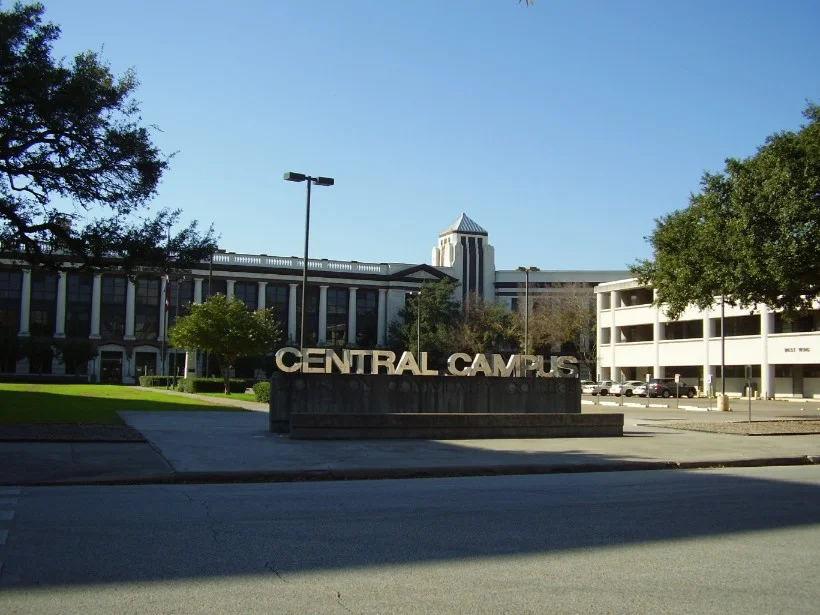
Public
Accredited · Southern Association of Colleges and Schools Commission on Colleges
Houston, Texas
A complete at-a-glance picture of every metric that matters for your 2026 application
Houston Community College TX Houston Community College is one of the largest community college systems in the United States and serves a highly diverse student population. It offers extensive transfer pathways, workforce certifications, technical training, and continuing education programs across numerous campuses.\n\nStudents benefit from strong industry connections within one of America's largest economic centers. Whether pursuing transfer to a university or direct entry into the workforce, students have access to a broad range of academic and professional opportunities.
Admission at Houston Community College is inclusive by design. 100% of applicants who meet basic eligibility are accepted.

A GPA a bit under the average isn't disqualifying at this tier. A solid test score or clear leadership record can offset it.
Source: IPEDS & College Scorecard (Nov 2025).
Houston Community College follows a Rolling Admissions policy, meaning applications are reviewed as they arrive and there is no single fixed deadline.
HCC reviews applications continuously throughout the year. Seats and scholarships are awarded on a first-come, first-served basis, so applying early gives you a significant advantage for both admission and financial aid.
Deadlines are verified from official institutional sources but may change each cycle. Always confirm final dates on the official website.
Built from Houston Community College's own verified admissions data — adjust the sliders below
Adjust the sliders to see how every decimal point affects your outcome.
⚠️ Note: Predicting based on regional averages as this institution does not publicly report full score datasets.
Calculated via College Portal's Human-Intelligence (HI) Methodology & Editorial Standards. Verified by Sohaib Ahmad Khan.
Scores aren't just a formality at HCC. Landing within or above the 2026 admitted class's middle 50% keeps you fully competitive, even where submission is optional.
HCC provides an open gateway to higher education. Success here is about using available resources well and planning your longer-term academic or career path.
The institution listed in IPEDS as Houston Community College (UNITID 225423) voted on June 18, 2025 to officially rename itself Houston City College, effective immediately. The name change was approved 6-3 by the Board of Trustees specifically to reflect the institution's new status as a bachelor's degree-granting institution - SACSCOC approved HCC's upgrade from Level I to Level II accreditation status in June 2024, enabling the college to award four-year degrees for the first time in its 54-year history. The IPEDS record, most third-party aggregators, employer databases, financial aid portals, and state systems still show the old name (Houston Community College) as of mid-2026. When applying, searching for financial aid, or referencing the institution in applications, you may encounter both names depending on the source. The school's own website now consistently uses Houston City College and hccs.edu; apply through the ApplyTexas application and confirm you are selecting the correct institution before submitting any materials.
HCC has open-door admissions - no GPA minimum, no SAT/ACT for admission, high school diploma or GED required, $0 application fee. But as a Texas public institution, all degree-seeking students must demonstrate college readiness through the Texas Success Initiative Assessment (TSIA2) before registering for most college-level courses. If you score below the college-readiness threshold, you will be placed in developmental courses that don't count toward your degree - losing time and tuition money. The good news: many students already qualify for TSI exemption without knowing it. SAT scores of 1070+ composite (with at least 500 on the critical reading section) exempt you from ELAR; 500+ SAT math or 19+ ACT math exempts you from the math section. Passing the Algebra II STAAR EOC (Level 2 score) also qualifies. Prior college coursework at an accredited institution qualifies you as well. If you took the SAT or ACT in high school and scored at or above these thresholds, submit your scores to HCC to claim the exemption and skip the TSIA2 entirely. Check your exemption status before scheduling any placement testing.
In fall 2023, Houston Community College became the first community college in Texas to offer a Bachelor of Applied Science in Healthcare Management and a Bachelor of Applied Technology in Artificial Intelligence - the latter making it the first community college in the nation to offer both an associate and a bachelor's degree in AI. A full bachelor's degree in AI at HCC is estimated to cost approximately $15,000, a fraction of the cost at four-year universities. The AI program's national reputation has drawn partnerships with Intel, Microsoft, Amazon Web Services, Nvidia, Apple, and Google - Google awarded HCC a $2 million grant in 2025 to hire additional AI faculty and expand the curriculum. A VICEROY cybersecurity program with Texas A&M University and the U.S. Department of Defense now trains students for civilian and commissioned careers with the NSA, CIA, Army, Navy, Air Force, Marines, and Space Force. HCC is the only community college in Texas selected for the VICEROY initiative. Students interested in AI, cybersecurity, or health care management should investigate these bachelor's programs specifically - they are not typical community college offerings, and the career partnerships attached to them are nationally significant.
HCC offers multiple structured transfer and co-enrollment pathways that allow students to complete bachelor's degrees without leaving the Houston area or navigating a standard competitive transfer admissions process. The UH/HCC Engineering Academy allows students to co-enroll simultaneously at the University of Houston and HCC, taking UH engineering courses while completing HCC general education requirements. A partnership with Texas A&M Victoria allows students to complete an HCC associate degree and transfer automatically to Texas A&M Victoria's Katy campus for a bachelor's degree in high-demand fields. The Houston GPS (Guided Pathways to Success) Consortium - now expanded to 15 college and university members - creates structured articulation agreements that map HCC coursework directly to bachelor's completion requirements at partner institutions. For students whose goal is a four-year degree, these pathways provide the clearest and most affordable route from HCC enrollment to a bachelor's without gaps, retakes, or credit loss. Ask an HCC academic advisor specifically about which pathway aligns with your intended bachelor's major before selecting your associate degree program.
Houston Community College (IPEDS UNITID 225423) renamed itself Houston City College effective June 18, 2025 - a decision approved 6-3 by the board, controversial enough that 50% of respondents to a local news poll said they disliked the new name. As of June 2026, many federal databases, employer records, transcript services, and financial aid systems still reference the institution as Houston Community College or HCCS (Houston Community College System). If you graduated from HCC before June 2025, your transcript will read "Houston Community College" - which may create confusion at receiving institutions, employers, or state agency databases that have updated to the new name. Conversely, documents issued after the name change will read "Houston City College." Confirm UNITID 225423 and hccs.edu (the website URL has not changed from hccs.edu as of this writing) before referencing any institutional data.
At $12,065/year against a $39,254 median graduate salary, HCC is worth weighing against your specific program and financial situation. The numbers below give you a real basis for that decision.
Admitted students' families report a median household income around $55,500, and graduates see a 4.83% unemployment rate.
Listed tuition runs $12,065/year at HCC. Factor in Pell and federal grant aid, and most students land closer to $6,738.
At HCC, 36.5% receive a Pell Grant and 16.1% carry federal loans. Filing FAFSA early and naming HCC on it improves your shot at both.
Ten years out from enrollment, HCC graduates report a median income of $39,254, somewhat below the U.S. median graduate income of $40,595.
Houston Community College graduates earn a lower median salary of $39,254/year, especially outside technical fields.
Tuition at Houston Community College is relatively affordable, around $12,065/year.
36.5% of Houston Community College students get a Pell Grant. Your odds depend mostly on household income, and filing FAFSA early still helps maximize what you're offered.
Houston Community College follows Rolling Admissions. Applications are reviewed year-round, so applying early is your best strategy.
Transferring in is a well-trodden path here. Line up your transcripts, recommendations, and a strong personal statement before applying.
The biggest levers are academic performance, a clear extracurricular focus, and essays that stand out, plus a solid test score where the school considers one.