
Public
Accredited · Southern Association of Colleges and Schools Commission on Colleges
Gainesville, Georgia
A complete at-a-glance picture of every metric that matters for your 2026 application
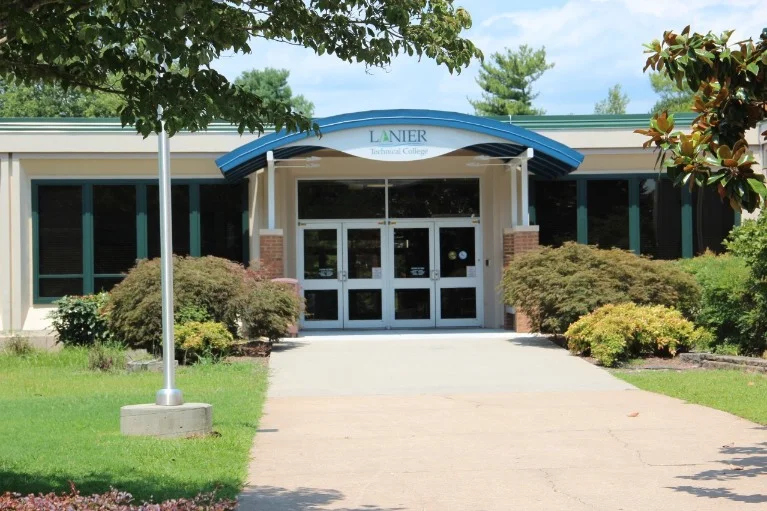
Lanier Technical College serves northeast Georgia from campuses in Oakwood, Dawsonville, and Winder. Established in 1964, Lanier Tech has grown into a comprehensive technical college offering 150+ degree and certificate programs to over 5,000 students annually. The campus features the 'Advanced Technology Center' with robotics labs, the 'Health Sciences Building' with simulation hospitals, and the 'Economic Development Center' for workforce training.
Lanier Tech excels in career-focused programs like aerospace manufacturing, nursing, and film production set design that support regional industries. The college's 'Quick Start' program provides customized training for employers like Kubota and Northeast Georgia Health System. Lanier Tech maintains strong apprenticeship programs in advanced manufacturing and healthcare fields. The college's 'Adult Education' program serves hundreds of students annually in basic skills and ESL instruction. Lanier Tech's commitment to accessibility includes the 'HOPE Career Grant' covering tuition for qualifying technical programs.
Admission at Lanier Technical College is inclusive by design. 100% of applicants who meet basic eligibility are accepted.

A GPA a bit under the average isn't disqualifying at this tier. A solid test score or clear leadership record can offset it.
Source: IPEDS & College Scorecard (Nov 2025).
Lanier Technical College follows a Rolling Admissions policy, meaning applications are reviewed as they arrive and there is no single fixed deadline, though the priority deadline of December 1 is recommended for the best chances of admission and financial aid.
Lanier Technical College reviews applications continuously throughout the year. Seats and scholarships are awarded on a first-come, first-served basis, so applying early gives you a significant advantage for both admission and financial aid.
Deadlines are verified from official institutional sources but may change each cycle. Always confirm final dates on the official website.
Built from Lanier Technical College's own verified admissions data — adjust the sliders below
Adjust the sliders to see how every decimal point affects your outcome.
⚠️ Note: Predicting based on regional averages as this institution does not publicly report full score datasets.
Calculated via College Portal's Human-Intelligence (HI) Methodology & Editorial Standards. Verified by Sohaib Ahmad Khan.
Scores aren't just a formality at Lanier Technical College. Landing within or above the 2026 admitted class's middle 50% keeps you fully competitive, even where submission is optional.
Lanier Technical College's open-access model means the real strategic decisions happen after enrollment: course planning, advising, and whether to transfer later.
Lanier Tech's Practical Nursing admission isn't a single competitive pool where every point matters equally - it's structured as two genuinely different outcomes depending on where your ATI TEAS score lands. Score 75% or higher, and you are guaranteed acceptance into the program outright, full stop, no further ranking or comparison against other applicants required. Score between 60% and 75%, and you enter a competitive ranking pool evaluated against the Practical Nursing Admissions Points Worksheet, where your fate depends on how your specific combination of GPA, prerequisites, and other weighted factors stacks up against everyone else in that band, with only the top-ranked applicants filling the 40 available Fall seats. This is a meaningfully different preparation strategy than most nursing programs offer: if your diagnostic TEAS practice scores are already landing in the high 60s or low 70s, the marginal value of additional study time is enormous, since crossing the 75% threshold doesn't just improve your ranking - it removes you from the ranking competition altogether and converts your application into a guarantee. Treat 75% not as "a good score" but as a specific, named threshold worth pushing hard for if you're anywhere close, since the two sides of that line represent fundamentally different admission outcomes.
Lanier Tech explicitly states it will not accept the ATI TEAS Allied Health Assessment if taken virtually, remotely proctored, or at any other institution - only an in-person sitting at a Lanier Tech campus counts, and even then only within a defined 12-month validity window tied to your specific target cohort. For a Fall 2026 application, for example, the qualifying window runs from June 1, 2025 through May 31, 2026 - meaning a TEAS score from April 2025, even a strong one, would have already expired by the time you apply, and a TEAS taken online through a proctoring service anywhere would be rejected regardless of score or timing. Before scheduling any TEAS attempt, confirm three things simultaneously: that you're testing physically on a Lanier Tech campus, that your test date falls inside the correct 12-month window for your intended cohort, and that you're leaving yourself enough runway before the application deadline to retake if your first attempt lands in the 60-75% competitive band rather than clearing 75% outright.
Interested applicants must be formally accepted into Lanier Technical College itself before they are eligible to apply to the Practical Nursing Program specifically - general college admission is an explicit prerequisite gate, not something you can complete simultaneously with your nursing application. Given that the Practical Nursing application deadline is fixed (the first Friday in June by noon, with only a single Fall, full-time, day-program cohort of 40 students offered each year - no Spring, Summer, or part-time options exist), and given that general admission itself takes processing time, don't treat "get into Lanier Tech" and "apply to Nursing" as two boxes you can check in the same week close to the June deadline. Sequence your general admission application months ahead of the nursing deadline specifically so you're not racing against both processes simultaneously in the final weeks before the cutoff.
Georgia's HOPE Career Grant, layered on top of the standard HOPE Grant for students who already qualify for and are receiving it, covers 100% of tuition costs in designated high-demand fields - Lanier Tech's own parent materials describe an education costing roughly $3,200 total dropping to about $1,200 per year with HOPE Grant alone, with HOPE Career Grant capable of closing that remaining gap entirely for eligible programs. Critically, the list of which specific programs qualify for HOPE Career Grant is determined annually by the Governor and Georgia General Assembly each spring, effective for that Fall's semester, and programs are added or removed from the list based on the Georgia Student Finance Commission's published criteria - meaning a program that qualified last year is not guaranteed to still qualify this year. Before building a financial plan around "my program will be tuition-free," check the current-year HOPE Career Grant program list directly with Lanier Tech's financial aid office rather than relying on last year's list or general reputation, since this is exactly the kind of policy detail that can shift annually without much public notice.
Applicants sometimes treat "meeting the minimum 60% TEAS threshold" as functionally equivalent to admission, especially if they've heard Lanier Tech has an open general-admissions philosophy - but the Practical Nursing Program is explicitly, repeatedly described in the college's own materials as selective, with the college stating outright that "meeting minimum requirements does not guarantee acceptance," since only the top 40 ranked applicants from the 60-75% competitive band are selected each Fall regardless of how many technically-eligible applicants apply. A student who barely clears 60% and assumes they're "in" because they met the stated minimum may be significantly underestimating how competitive that specific band actually is in any given cycle, since Lanier Tech doesn't publish real-time information about how many applicants are competing for those remaining seats below the 75% guarantee line.
At $13,193/year against a $37,623 median graduate salary, Lanier Technical College is worth weighing against your specific program and financial situation. The numbers below give you a real basis for that decision.
Admitted students' families report a median household income around $65,200, and graduates see a 2.39% unemployment rate.
Listed tuition runs $13,193/year at Lanier Technical College. Factor in Pell and federal grant aid, and most students land closer to $5,613.
At Lanier Technical College, 27.8% receive a Pell Grant and % carry federal loans. Filing FAFSA early and naming Lanier Technical College on it improves your shot at both.
Ten years out from enrollment, Lanier Technical College graduates report a median income of $37,623, somewhat below the U.S. median graduate income of $40,595.
Lanier Technical College graduates earn a lower median salary of $37,623/year, especially outside technical fields.
Tuition at Lanier Technical College is relatively affordable, around $13,193/year.
27.8% of Lanier Technical College students get a Pell Grant. Your odds depend mostly on household income, and filing FAFSA early still helps maximize what you're offered.
Lanier Technical College's deadline is December 1 (Rolling). Rolling Admissions applies too, so earlier is always better.
Lanier Technical College charges an application fee of 25; ask admissions about waiver eligibility if cost is a barrier.
Transferring in is a well-trodden path here. Line up your transcripts, recommendations, and a strong personal statement before applying.
The biggest levers are academic performance, a clear extracurricular focus, and essays that stand out, plus a solid test score where the school considers one.