
Non-Profit Private
Accredited · Higher Learning Commission
Santa Fe, New Mexico
49.5% Acceptance Rate
A complete at-a-glance picture of every metric that matters for your 2026 application
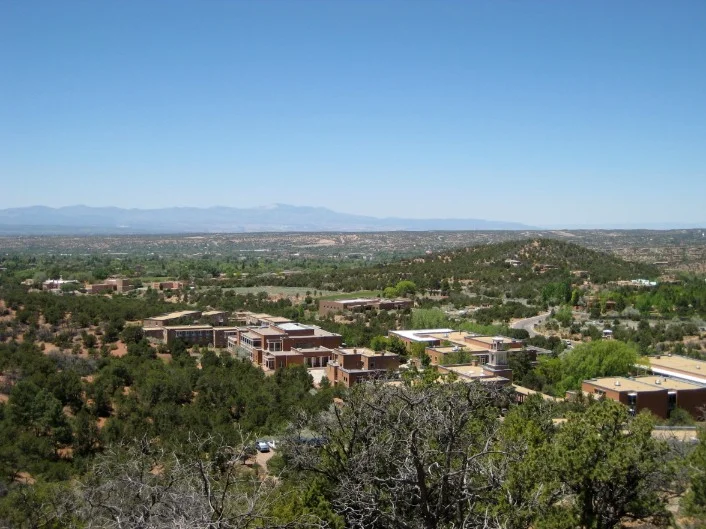
St. John's College, founded in 1696, is renowned for its Great Books curriculum, emphasizing classical liberal arts education. Located in Annapolis, Maryland, and Santa Fe, New Mexico, it consistently ranks among the top liberal arts colleges for its unique seminar-based learning. The college offers intimate class sizes, historic campuses, and a strong focus on philosophy and literature.
With no traditional majors, St. John's fosters critical thinking through primary texts. Its small student body and low student-faculty ratio ensure personalized attention, while its libraries and labs support deep intellectual exploration. The scenic campuses provide a serene environment for rigorous academic engagement.
St. John's College is selective but reasonable. About 49.5% of applicants (50 per 100) are admitted each cycle.

Slightly below-average GPA? A strong test score or clear leadership track record can still keep you competitive.
Source: IPEDS & College Scorecard (Nov 2025).
The application deadline for St. John's College is November 15 for Early Decision applicants, with additional plans listed below. Admission decisions are typically released by December 15.
💡 The scholarship deadline (December 1, 2026) often falls before the regular admission deadline. Submit your application and FAFSA early to be considered for maximum aid.
Deadlines are verified from official institutional sources but may change each cycle. Always confirm final dates on the official website.
The average GPA of admitted students at St. John's College is 3.74. That makes admissions here highly selective. Most admitted students carry mostly A's with the occasional B.
Between 3.44 and 3.74? A strong standardized test score is worth prioritizing.
Most schools report GPA on a weighted or unweighted 4.0 scale differently. For an unweighted profile like this, students with AP/IB coursework typically carry a weighted GPA of 3.94–4.14.Assessment: Highly selective; GPA is within the typical admitted range.
Recommended Strategy: Standardized Test Scores (SAT/ACT) in the top 5th percentile.
Where your GPA falls in this range shapes what the rest of your application needs to do:
Data verified via IPEDS, College Scorecard (Nov 2025) and the Common Data Set (CDS). Expert Review led by Sohaib Khan and Dr. Waseem.
Real-Time Sensitive Analysis — based on St. John's College's verified institutional data
Adjust the sliders to see how every decimal point affects your outcome.
✅ Verified Data: Institutional records for 2026.
Calculated via College Portal's Human-Intelligence (HI) Methodology & Editorial Standards. Verified by Sohaib Ahmad Khan.
Standardized scores still matter here: aim for the middle 50% range of the 2026 admitted class below, and if St. John's College is test-optional, a high score submitted voluntarily still helps with merit scholarships.
The average SAT score of admitted students at St. John's College is 1367 on the 1600-point scale.
This average is solidly above the national mean, without being in elite-tier territory.
If your score is below 1260, retaking the SAT is strongly recommended to improve your chances at St. John's College. Retaking multiple times is completely normal. Most competitive applicants sit for it two or three times. There's no official limit on attempts.
| Section | Average | 25th Percentile | 75th Percentile |
|---|---|---|---|
| SAT Math | 640 | 580 | 700 |
| SAT Reading | 715 | 680 | 750 |
| SAT Composite | 1367 | 1260 | 1450 |
Below 1260, you're behind most admitted students; at 1450 or above, you're ahead of 75% of them. (25th/75th percentile = the score below which that share of admitted students fall.)
View list of all colleges with average SAT score of 1350
A 1450 SAT puts you ahead of most of St. John's College's admitted class, but admissions still weighs GPA, course rigor, and essays alongside it. A strong score opens the door; the rest of your profile decides what happens next.
The average ACT score at St. John's College is 29.
This average is solidly above the national mean without being elite-tier.
| Section | Average | 25th Percentile | 75th Percentile |
|---|---|---|---|
| ACT Math | 27 | 25 | 28 |
| ACT English | 32 | 29 | 34 |
| ACT Composite | 29 | 27 | 31 |
A 31 ACT puts you ahead of 75% of St. John's College's admitted students. That's a strong position, though the ACT is only one benchmark among several that admissions weighs.
Unlike the SAT, the ACT scores four separate sections: English, Math, Reading, and Science, each on a 1–36 scale. A noticeably weak section, especially Science at STEM-focused schools, stands out to reviewers, so it's worth checking your section breakdown for outliers before applying.
Your ACT score clears the first filter, but GPA, course rigor, extracurricular depth, recommendations, and essays are what carry an application the rest of the way at St. John's College.
At St. John's College, admissions looks for reliable, high-achieving students. The goal is to land as a top-tier applicant. That's what triggers both admission and the best merit aid.
St. John's offers two genuinely different paths: the standard written application (Common App/St. John's App/Coalition App with a 400-word essay plus an optional 200-word essay) or the Discussion-Based Application, which replaces essays with an admissions-counselor interview, a faculty interview, and participation in a live Socratic seminar (satisfied via a free online seminar or the Summer Academy). If you're a stronger talker than writer, the Discussion-Based track - due by January 15 under Early Decision or Early Action only - is a legitimate, underused alternative; don't default to the written essay just because it's more familiar.
The core 400-word essay asks why a specific book matters to you and how it connects to your identity, worldview, or values - admissions readers explicitly flag pop-fiction choices like Harry Potter or The Da Vinci Code as self-aggrandizing or pandering picks that undercut the essay's purpose. Choose a book that actually shaped how you think, skip plot summary entirely, and spend your 400 words on the impact and the thinking it provoked, not the story.
St. John's is explicit that the Socratic seminar requirement isn't a debate to win - admissions is looking for students who "carry on a genuine conversation with their peers," not the loudest voice in the room. In your practice seminar or Summer Academy session, practice building on others' points and asking real questions rather than delivering pre-formed positions; this directly mirrors what the tutors (not "professors") expect in actual seminar classrooms once you're enrolled.
St. John's has no majors or departments - every student earns the same interdisciplinary Bachelor of Arts in Liberal Arts built entirely around the Great Books curriculum. An applicant who pitches a narrow pre-professional intent ("I want to study only philosophy" or "I'm here for pre-med") signals a structural mismatch with a school that has no way to accommodate that. Instead, use your essay and any interview to show genuine curiosity across at least two or three disciplines (e.g., mathematics and literature, or history and science) - that range is what the curriculum itself rewards.
The most common misstep is treating the "why this school" logic like a normal liberal arts college - praising specific electives, professors by name, or a major program - when St. John's has none of that; readers can tell immediately when an essay was written for a generic liberal arts college and lightly edited to insert "St. John's," since the entire curriculum is a single shared course of study with no ? la carte options to name-drop.
St. John's College offers a rigorous academic environment, but 'worth it' is a personal calculation of cost, program fit, and outcomes. The figures below are a starting point.
The average household income among admitted students is $73,400, with a graduate unemployment rate of 3.11%.
The sticker price is $53,018/year, but the average net price students actually pay, after Pell and federal grants, is typically much lower.
24.2% of students receive a Pell Grant and 42.6% take federal loans at St. John's College. File your FAFSA early and list St. John's College as a choice to be considered for both.
Median earnings 10 years after enrollment (roughly 4–6 years post-graduation) are $44,985. That's about 11% above the U.S. median graduate income.

These schools have lower average SAT or ACT scores than St. John's College. If your SAT or ACT score is slightly lower, you'll be competitive for these schools.
| School | Location | SAT | ACT |
|---|---|---|---|
| University of Alabama in Huntsville | Huntsville, AL | 1321 | 28 |
| Auburn University | Auburn, AL | 1318 | 28 |
| Hendrix College | Conway, AR | 1336 | 29 |
| Chapman University | Orange, CA | 1353 | 30 |
| University of Colorado Boulder | Boulder, CO | 1353 | 31 |
| University of Denver | Denver, CO | 1344 | 31 |
| University of Connecticut | Storrs, CT | 1338 | 31 |
| Fairfield University | Fairfield, CT | 1323 | 31 |
| Florida State University | Tallahassee, FL | 1323 | 29 |
| Centre College | Danville, KY | 1345 | 29 |

These schools have the same range of average SAT or ACT scores as St. John's College. If your SAT or ACT score is competitive, you'll be competitive for these schools also.
| School | Location | SAT | ACT |
|---|---|---|---|
| Pepperdine University | Malibu, CA | 1367 | 29 |
| Westmont College | Santa Barbara, CA | 1367 | 32 |
| United States Air Force Academy | USAF Academy, CO | 1362 | 30 |
| Wheaton College | Wheaton, IL | 1363 | 30 |
| Emerson College | Boston, MA | 1359 | 32 |

These schools have higher average SAT or ACT scores than St. John's College. If you improve your SAT or ACT score, you'll be competitive for these schools.
| School | Location | SAT | ACT |
|---|---|---|---|
| Santa Clara University | Santa Clara, CA | 1417 | 32 |
| Colorado College | Colorado Springs, CO | 1445 | 33 |
| Colorado School of Mines | Golden, CO | 1403 | 31 |
| Connecticut College | New London, CT | 1412 | 32 |
| George Washington University | Washington, DC | 1433 | 33 |
Median earnings for St. John's College graduates sit around $44,985 a year.
At about $53,018 a year, St. John's College's cost is on the higher end; look closely at aid options.
St. John's College's Pell Grant rate of 24.2% sits below the national average. Merit-based aid is worth checking regardless of income.
At 49.5%, St. John's College's acceptance rate is on the more attainable end compared to top-tier selective schools.
Admitted students at St. John's College average a 3.74 GPA.
St. John's College doesn't publish a hard GPA floor, but landing at or above 3.44 keeps you in the typical applicant range; below it, lean on essays and recommendations.
Below 3.34, St. John's College becomes a harder reach, though a strong test score, meaningful activities, and AP/IB coursework can still make a real case.
A strong SAT score matters at St. John's College — aim above 1367, ideally within the 1260–1450 range admitted students typically fall in.
The application deadline for St. John's College is November 15 for Early Decision applicants. Admission decisions are released by December 15.
The scholarship/financial aid priority deadline is December 1, 2026. Submit FAFSA before then for maximum consideration.
Yes, transfers are common. Have transcripts, recommendation letters, and a solid personal statement ready to make your case.
Strong academics, a focused extracurricular profile, and standout essays move the needle most, along with a competitive SAT/ACT score where relevant.