
Public
Accredited · Western Association of Schools and Colleges Accrediting Commission for Community and Junior Colleges
Berkeley, California
A complete at-a-glance picture of every metric that matters for your 2026 application
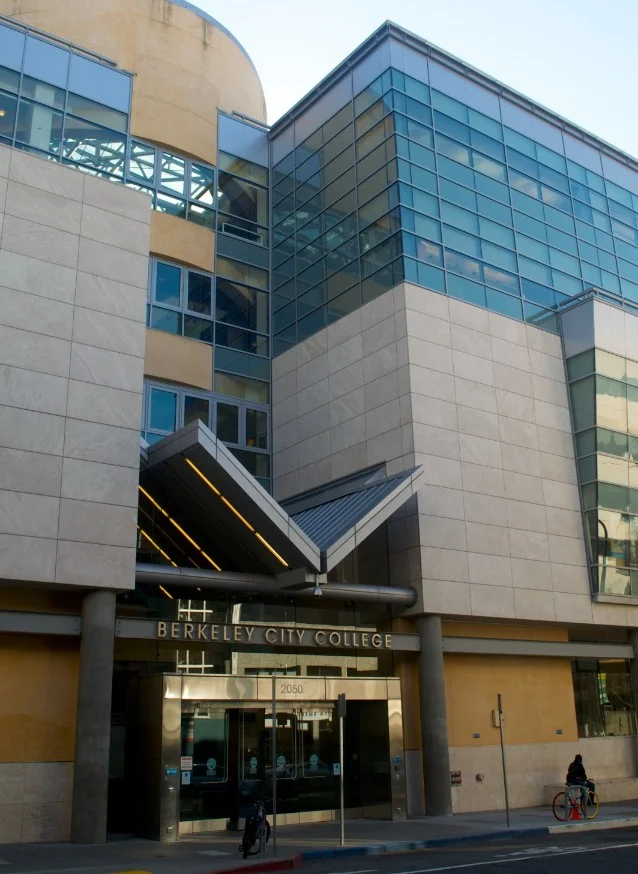
Berkeley City College serves California's East Bay from its urban campus in downtown Berkeley. Established in 1974 as Vista College, BCC became an independent college in 2006 offering 50+ degree and certificate programs. The six-story campus features the 'Atrium' student center, multimedia production labs, and the 'Live Oak Center' for student services.
BCC excels in transfer preparation with guaranteed admission to UC Berkeley through the 'Transfer Alliance Project.' The college's 'Metro Academy' provides intensive support for first-generation students. BCC maintains strong programs in social justice studies, digital media, and biotechnology reflecting its diverse urban community. The college's 'Basic Needs Center' addresses food and housing insecurity among students. BCC's commitment to equity includes the 'Umoja' and 'Puente' programs supporting African American and Latino student success.
Berkeley City College runs an open-access admission policy. With a 100% acceptance rate, the focus is on getting qualified students in, not filtering them out.

Slightly below-average GPA? A strong test score or clear leadership track record can still keep you competitive.
Source: IPEDS & College Scorecard (Nov 2025).
Berkeley City College follows a Rolling Admissions policy, meaning applications are reviewed as they arrive and there is no single fixed deadline.
Berkeley City College reviews applications continuously throughout the year. Seats and scholarships are awarded on a first-come, first-served basis, so applying early gives you a significant advantage for both admission and financial aid.
Deadlines are verified from official institutional sources but may change each cycle. Always confirm final dates on the official website.
Real-Time Sensitive Analysis — based on Berkeley City College's verified institutional data
Adjust the sliders to see how every decimal point affects your outcome.
⚠️ Note: Predicting based on regional averages as this institution does not publicly report full score datasets.
Calculated via College Portal's Human-Intelligence (HI) Methodology & Editorial Standards. Verified by Sohaib Ahmad Khan.
Standardized scores still matter here: aim for the middle 50% range of the 2026 admitted class below, and if Berkeley City College is test-optional, a high score submitted voluntarily still helps with merit scholarships.
Getting into Berkeley City College is the easy part. What matters next is using placement testing, advising, and available resources to set up a strong first year.
Six of the nine UC campuses offer the Transfer Admission Guarantee (TAG) to California community college students, but UC Berkeley, UCLA, and UC San Diego are the three that don't - meaning there's no contractual guarantee, however well you perform. Berkeley City College's Career & Transfer Center runs the Starting Point Mentorship Program, which pairs eligible students with current UC Berkeley student mentors, and hosts the Experience Berkeley recruitment cycle each spring for students transferring the following fall. Students targeting UC Berkeley specifically should enroll in Starting Point in their first year rather than discovering it as a senior, since mentor pairing and admissions guidance compound over time.
For the six UCs that do offer TAG (Davis, Irvine, Merced, Riverside, Santa Barbara, Santa Cruz), the guarantee only applies if you've completed 30+ transferable units and meet major-specific GPA and coursework requirements by the time you submit - and you can only hold a TAG agreement with one campus at a time. Meet with a BCC counselor in your very first semester to open a TAG contract at a realistic campus, even if UC Berkeley remains your reach; this locks in a guaranteed admission as insurance while you build the stronger application needed for a non-TAG campus.
The Associate in Arts for Transfer (AA-T) or Associate in Science for Transfer (AS-T) - California's "degree with a guarantee" - gives priority admission to CSU campuses for students who complete it and meet minimum eligibility. Community college students who take transferable classes without deliberately mapping them to an ADT often end up completing 26 more units than necessary to transfer, per CCC system data - work with a BCC academic counselor from term one to build an ADT-aligned educational plan rather than accumulating credits ad hoc.
BCC's Career and Transfer Center flags consideration for transfer scholarships specifically for students with a 3.2 GPA or higher (funding-dependent), separate from any CSU or UC financial aid. Since this threshold is a real cutoff rather than a soft target, students hovering near 3.2 in their second year should prioritize a lighter, higher-GPA course load in their final semester before applying, rather than front-loading difficult transfer-prep courses into the term right before applications are due.
Because "TAG guarantees UC transfer" is widely repeated advice, students frequently assume it applies to UC Berkeley itself - it doesn't, and no comparable guarantee exists for Cal or UCLA. Presenting TAG as a blanket safety net without clarifying which specific campuses participate is the most common way a Berkeley City College student's transfer plan collapses senior year when they realize their target campus was never covered.
At $17,110/year against a $41,217 median graduate salary, Berkeley City College is worth weighing against your specific program and financial situation. The numbers below give you a real basis for that decision.
The average household income among admitted students is $59,400, with a graduate unemployment rate of 4.23%.
The sticker price is $17,110/year, but the average net price students actually pay, after Pell and federal grants, is closer to $8,957.
12.6% of students receive a Pell Grant and 1% take federal loans at Berkeley City College. File your FAFSA early and list Berkeley City College as a choice to be considered for both.
Median earnings 10 years after enrollment (roughly 4–6 years post-graduation) are $41,217. That's about 2% above the U.S. median graduate income.
Median earnings for Berkeley City College graduates sit around $41,217 a year.
At about $17,110 a year, Berkeley City College is on the more affordable end.
Berkeley City College's Pell Grant rate of 12.6% sits below the national average. Merit-based aid is worth checking regardless of income.
Berkeley City College follows Rolling Admissions. Applications are reviewed year-round, so applying early is your best strategy.
Yes, transfers are common. Have transcripts, recommendation letters, and a solid personal statement ready to make your case.
Strong academics, a focused extracurricular profile, and standout essays move the needle most, along with a competitive SAT/ACT score where relevant.