
Non-Profit Private
Accredited · Middle States Commission on Higher Education
Washington, District of Columbia
13.1% Acceptance Rate
A complete at-a-glance picture of every metric that matters for your 2026 application
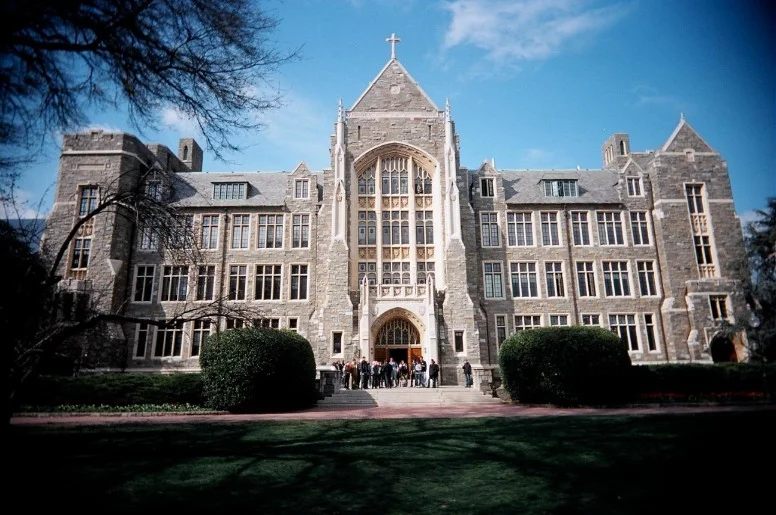
Georgetown University, established in 1789, is the oldest Catholic and Jesuit university in the U.S. Located in Washington, D.C., Georgetown excels in international relations, law, and medicine. The university's Walsh School of Foreign Service is a pipeline to diplomatic careers. Georgetown's research addresses global challenges through institutes like the McCourt School of Public Policy.
The campus blends historic Healy Hall with modern facilities like the Hariri Building. Alumni include U.S. presidents and global leaders. Georgetown's emphasis on men and women for others shapes its service-oriented culture. Its D.C. location provides unmatched access to policy and internship opportunities.
Georgetown University accepted just 13.1% of applicants last cycle, roughly 13 out of every 100 who applied, placing it among the most selective schools among colleges in District of Columbia.

Average scores just get you in the conversation here. What actually separates admits from the rest of a strong pool is the essays and recommendations.
Source: IPEDS & College Scorecard (Nov 2025).
Mark November 1 for Georgetown University (Early Action — other plans are listed below), with decisions typically out by December 15.
💡 The scholarship deadline (February 1, 2026) often falls before the regular admission deadline. Submit your application and FAFSA early to be considered for maximum aid.
Deadlines are verified from official institutional sources but may change each cycle. Always confirm final dates on the official website.
The average GPA of admitted students at GU is 3.89. That makes admissions here extremely selective. Most admitted students carry straight A's, with very little room for a B.
If your GPA sits between 3.59 and 3.89, a high SAT or ACT score is the most reliable way to compensate.
Note the scale: this figure reflects an unweighted 4.0 GPA. Add AP or IB coursework and the equivalent weighted GPA usually lands around 4.09–4.29.Assessment: Highly selective. This GPA sits within the typical admitted band.
Recommended Strategy: A top-5th-percentile SAT/ACT score makes the strongest case here.
This range is a rough map. Where you land determines what else needs to carry weight in your application.:
Data verified via IPEDS, College Scorecard (Nov 2025) and the Common Data Set (CDS). Expert Review led by Sohaib Khan and Dr. Waseem.
Built from Georgetown University's own verified admissions data — adjust the sliders below
Adjust the sliders to see how every decimal point affects your outcome.
✅ Verified Data: Institutional records for 2026.
Calculated via College Portal's Human-Intelligence (HI) Methodology & Editorial Standards. Verified by Sohaib Ahmad Khan.
Scores aren't just a formality at GU. Landing within or above the 2026 admitted class's middle 50% keeps you fully competitive, even where submission is optional.
Admitted students at Georgetown University average a 1494 SAT (out of 1600).

GU's SAT average sits comfortably in the upper range nationally.
Scored under 1390? A retake is worth it at GU. Two or three sittings is standard for competitive applicants, and there's no cap on how many times you can test.
| Section | Average | 25th Percentile | 75th Percentile |
|---|---|---|---|
| SAT Math | 735 | 690 | 780 |
| SAT Reading | 735 | 700 | 770 |
| SAT Composite | 1494 | 1390 | 1550 |
A score under 1390 puts you in the lower quarter of admits; 1550+ puts you ahead of three-quarters of the admitted class. (These percentiles mark where a given share of the admitted class scored at or below.)
View list of all colleges with average SAT score of 1500
At 1550, your SAT is squarely in GU's favor. That said, admissions staff read the full file. GPA, activities, and essays still carry real weight even with a strong score in hand.
GU's admitted students average an ACT of 33.
GU's ACT average sits comfortably in the upper range nationally.
| Section | Average | 25th Percentile | 75th Percentile |
|---|---|---|---|
| ACT Math | 32 | 29 | 35 |
| ACT English | 35 | 34 | 35 |
| ACT Composite | 33 | 32 | 34 |
At 34, you're in the top quarter of GU's admitted class by ACT score. That's a real advantage, but admissions still reads GPA, essays, and activities alongside it.
The ACT's four sections, English, Math, Reading, and Science, are each scored independently on a 1–36 scale, and admissions staff do notice a lopsided breakdown. If one section trails the others significantly, that's worth addressing before you apply, particularly for STEM programs where Science carries extra weight.
Beyond the number itself, GU weighs your transcript rigor, activities, recommendations, and essays just as heavily. The ACT opens the door, and the rest of your file decides what happens next.
To succeed at a world-class institution like GU, move beyond 'well-rounded' and show you're institutionally necessary, with a specific, undeniable strength rather than a broad set of decent ones.
Georgetown is one of the very few remaining highly selective universities in the country that requires SAT or ACT scores from all applicants - there are no exceptions and no test-optional pathway. This single policy fundamentally changes your preparation strategy. Strong standardized test scores are a genuine differentiator at Georgetown in a way they are no longer at most peer institutions. Critically, Georgetown does not participate in Score Choice - you must submit your complete testing history, including every sitting. Consistent upward improvement across sittings can leave a positive impression, but erratic or declining scores will raise flags. Submit AP scores as well; Georgetown recommends them and strong AP results reinforce your academic transcript in the committee's eyes.
Georgetown requires four essay responses: a special talents or skills essay (250 words), a "most meaningful activity" essay (roughly half a page), a personal or creative diversity essay, and a school-specific essay that changes based on which of Georgetown's four undergraduate schools you are applying to. The school-specific prompt is the one most applicants underinvest in - and it is the one the committee uses most directly to assess fit. Applicants to the College of Arts and Sciences must describe something that genuinely changed their thinking; SFS applicants must connect their goals to Georgetown's global leadership mission; MSB applicants must articulate their professional and ethical vision. Each requires deep, specific engagement with Georgetown's identity. Generic or recycled essays from other applications are transparently obvious to readers who evaluate Georgetown applications exclusively.
Georgetown is one of the only elite universities still requiring alumni interviews for virtually all applicants - a meaningful distinction that most prospective students underestimate. Submitting the Georgetown Application immediately initiates the interview assignment process, conducted by local alumni between September and February. EA applicants are prioritized for October interviews, so submitting early gives you more preparation time. Treat this as a genuine two-way conversation: Georgetown explicitly encourages you to use the interview to learn about the school, not just to perform for the reader. Come prepared to discuss your essays in depth, reference specific programs, faculty, or Georgetown initiatives that align with your goals, and ask substantive questions. Interviewers who feel you have genuinely researched Georgetown - its Jesuit identity, its D.C. location, its research institutes - leave the conversation with a stronger impression of your fit.
Georgetown offers non-binding Early Action with a November 1 deadline and decisions by mid-December - but its EA mechanics are critically different from most peer institutions. EA applicants who are not admitted outright are deferred to the Regular Decision round rather than denied, and only about 15% of deferred students are ultimately admitted. Georgetown's EA is also restrictive, meaning you cannot simultaneously apply to binding Early Decision programs at other schools. If Georgetown is a genuine top choice, apply EA - the committee views early applicants favorably for their demonstrated seriousness of interest. Importantly, Georgetown does not formally track demonstrated interest metrics like campus visits or email contacts, but proactively mentioning in your essays why Georgetown specifically fits your goals is not the same thing as manufactured demonstrated interest, and it is actively rewarded.
Whether GU is worth it depends less on its reputation and more on your program choice, financial aid package, and career goals. Here's the data to weigh it against.
Admitted students' families report a median household income around $82,200, and graduates see a 3.09% unemployment rate.
Listed tuition runs $84,696/year at GU. Factor in Pell and federal grant aid, and most students land typically much lower.
At GU, 10.3% receive a Pell Grant and 19.4% carry federal loans. Filing FAFSA early and naming GU on it improves your shot at both.
Ten years out from enrollment, GU graduates report a median income of $103,494, about 155% above the U.S. median graduate income.

These schools have lower average SAT or ACT scores than Georgetown University. If your SAT or ACT score is slightly lower, you'll be competitive for these schools.
| School | Location | SAT | ACT |
|---|---|---|---|
| Northeastern University Oakland | Oakland, CA | 1472 | 32 |
| Occidental College | Los Angeles, CA | 1461 | 33 |
| Scripps College | Claremont, CA | 1480 | 33 |
| Colorado College | Colorado Springs, CO | 1445 | 33 |
| Georgia Institute of Technology-Main Campus | Atlanta, GA | 1447 | 31 |
| Bates College | Lewiston, ME | 1446 | 32 |
| University of Maryland-College Park | College Park, MD | 1463 | 34 |
| Boston University | Boston, MA | 1473 | 33 |
| Brandeis University | Waltham, MA | 1473 | 33 |
| Smith College | Northampton, MA | 1480 | 33 |

These schools have the same range of average SAT or ACT scores as Georgetown University. If your SAT or ACT score is competitive, you'll be competitive for these schools also.
| School | Location | SAT | ACT |
|---|---|---|---|
| University of Southern California | Los Angeles, CA | 1501 | 34 |
| Grinnell College | Grinnell, IA | 1486 | 33 |
| Colby College | Waterville, ME | 1500 | 33 |
| Amherst College | Amherst, MA | 1494 | 33 |
| Boston College | Chestnut Hill, MA | 1501 | 34 |

These schools have higher average SAT or ACT scores than Georgetown University. If you improve your SAT or ACT score, you'll be competitive for these schools.
| School | Location | SAT | ACT |
|---|---|---|---|
| Harvey Mudd College | Claremont, CA | 1537 | 35 |
| Yale University | New Haven, CT | 1534 | 34 |
| University of Chicago | Chicago, IL | 1554 | 35 |
| Northwestern University | Evanston, IL | 1526 | 34 |
| Johns Hopkins University | Baltimore, MD | 1553 | 35 |
Graduates of Georgetown University earn a high median salary of $103,494/year, varying by field.
Tuition at Georgetown University runs high, at roughly $84,696+/year, so financial aid planning matters.
10.3% receive a Pell Grant here, below the ~35% national average. Georgetown University skews toward higher-income students, though merit aid may still be worth checking.
Georgetown University's acceptance rate is 13.1%, in the 10–20% band. Admission is very competitive and requires a strong academic profile.
The average GPA of admitted Georgetown University students is 3.89, reflecting a competitive applicant pool.
There's no strict cutoff, but a GPA at or above 3.59 puts you in the standard applicant pool at Georgetown University. Below that, your essays and recommendations need to work harder to provide context.
A GPA of 3.49 or below makes admission tougher at Georgetown University, but strong test scores, activities, and essays, plus AP/IB coursework, can still keep you in contention.
Georgetown University weighs the SAT heavily. Scoring above 1494, and within the 1390–1550 range, keeps you competitive.
Georgetown University's deadline is November 1 (Early Action), with decisions out by December 15.
Georgetown University charges an application fee of 75; ask admissions about waiver eligibility if cost is a barrier.
For priority financial aid consideration, get your FAFSA in before February 1, 2026. That's Georgetown University's scholarship priority date.
Transferring in is a well-trodden path here. Line up your transcripts, recommendations, and a strong personal statement before applying.
The biggest levers are academic performance, a clear extracurricular focus, and essays that stand out, plus a solid test score where the school considers one.