
Non-Profit Private
Accredited · Middle States Commission on Higher Education
Baltimore, Maryland
7.6% Acceptance Rate
A complete at-a-glance picture of every metric that matters for your 2026 application
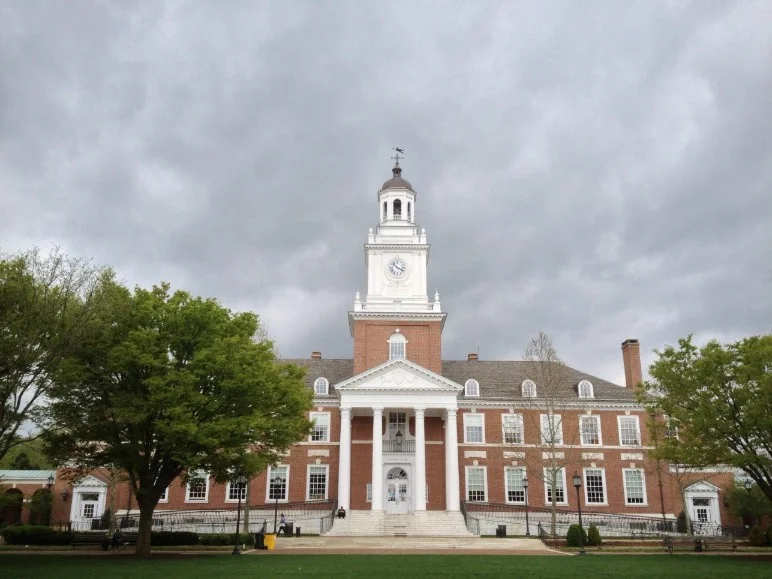
Johns Hopkins University (JHU), established in 1876, is America's first research university, based in Baltimore, Maryland. JHU pioneered the modern graduate education model and remains a leader in medicine, public health, and international studies. The university's Hospital and Applied Physics Lab are global research powerhouses. JHU's Homewood Campus blends Collegiate Gothic architecture with cutting-edge STEM facilities.
JHU emphasizes discovery and innovation, with undergraduate research opportunities in every field. The university's global presence includes campuses in Italy and China. Alumni include Nobel laureates and leaders in science and diplomacy. JHU's commitment to solving humanity's greatest challenges from pandemics to space exploration makes it a beacon of research excellence.
With a 7.6% acceptance rate, Johns Hopkins University sits firmly in the elite tier of US admissions. Only 8 in 100 applicants are offered a seat.

Average scores just get you in the conversation here. What actually separates admits from the rest of a strong pool is the essays and recommendations.
Source: IPEDS & College Scorecard (Nov 2025).
Mark November 1 for Johns Hopkins University (Early Decision I — other plans are listed below), with decisions typically out by December 15.
💡 The scholarship deadline (November 1, 2026) often falls before the regular admission deadline. Submit your application and FAFSA early to be considered for maximum aid.
Deadlines are verified from official institutional sources but may change each cycle. Always confirm final dates on the official website.
The average GPA of admitted students at Johns Hopkins is 3.92. That makes admissions here extremely selective. Most admitted students carry straight A's, with very little room for a B.
If your GPA sits between 3.62 and 3.92, a high SAT or ACT score is the most reliable way to compensate.
Note the scale: this figure reflects an unweighted 4.0 GPA. Add AP or IB coursework and the equivalent weighted GPA usually lands around 4.12–4.32.Assessment: This tier demands elite, top-of-class academic standing.
Recommended Strategy: Pair the GPA with heavy Course Rigor, including AP, IB, or Honors, to back it up.
This range is a rough map. Where you land determines what else needs to carry weight in your application.:
Data verified via IPEDS, College Scorecard (Nov 2025) and the Common Data Set (CDS). Expert Review led by Sohaib Khan and Dr. Waseem.
Built from Johns Hopkins University's own verified admissions data — adjust the sliders below
Adjust the sliders to see how every decimal point affects your outcome.
✅ Verified Data: Institutional records for 2026.
Calculated via College Portal's Human-Intelligence (HI) Methodology & Editorial Standards. Verified by Sohaib Ahmad Khan.
Scores aren't just a formality at Johns Hopkins. Landing within or above the 2026 admitted class's middle 50% keeps you fully competitive, even where submission is optional.
Admitted students at Johns Hopkins University average a 1553 SAT (out of 1600).
Very few schools post an average this high; a 1553 puts Johns Hopkins among the most academically selective by SAT alone.
Scored under 1530? A retake is worth it at Johns Hopkins. Two or three sittings is standard for competitive applicants, and there's no cap on how many times you can test.
| Section | Average | 25th Percentile | 75th Percentile |
|---|---|---|---|
| SAT Math | 790 | 780 | 800 |
| SAT Reading | 765 | 750 | 780 |
| SAT Composite | 1553 | 1530 | 1580 |
A score under 1530 puts you in the lower quarter of admits; 1580+ puts you ahead of three-quarters of the admitted class. (These percentiles mark where a given share of the admitted class scored at or below.)
View list of all colleges with average SAT score of 1550
At 1600, your SAT is squarely in Johns Hopkins's favor. That said, admissions staff read the full file. GPA, activities, and essays still carry real weight even with a strong score in hand.
Johns Hopkins's admitted students average an ACT of 35.
Very few institutions post an ACT average this high — 35 is elite-tier.
| Section | Average | 25th Percentile | 75th Percentile |
|---|---|---|---|
| ACT Math | 35 | 33 | 36 |
| ACT English | 36 | 35 | 36 |
| ACT Composite | 35 | 34 | 35 |
At 35, you're in the top quarter of Johns Hopkins's admitted class by ACT score. That's a real advantage, but admissions still reads GPA, essays, and activities alongside it.
The ACT's four sections, English, Math, Reading, and Science, are each scored independently on a 1–36 scale, and admissions staff do notice a lopsided breakdown. If one section trails the others significantly, that's worth addressing before you apply, particularly for STEM programs where Science carries extra weight.
Beyond the number itself, Johns Hopkins weighs your transcript rigor, activities, recommendations, and essays just as heavily. The ACT opens the door, and the rest of your file decides what happens next.
Johns Hopkins isn't looking for well-rounded applicants. It's looking for 'pointy.' The strategy here is to make your one strongest area impossible to overlook.
JHU's 2025-26 required essay (350 words) is built around the university's 150th anniversary with the explicit prompt: "Tell us about an important first in your life - big or small - that has shaped you." The examples Hopkins itself uses (first draft, first prototype, first pitch) signal that the "first" should anchor a narrative about discovery and intellectual or personal formation, not a childhood milestone disconnected from Hopkins's research and innovation identity. Help students identify a "first" that reveals how they think and what they value - then connect it organically to what they'd pursue at Hopkins rather than forcing a generic "I will contribute to Hopkins" closing line.
Hopkins requires just one supplemental essay, which means this single piece of writing is the only school-specific differentiation available to every applicant. Essays are explicitly listed among the five factors Hopkins rates "very important" (alongside rigor, GPA, class rank, and recommendations). With roughly 19 of 20 regular-decision applicants ultimately denied, a thoughtful, specific, and well-crafted 350-word response is not a finishing touch - it is the application's primary personal statement for Hopkins specifically.
Students interested in combining music with a liberal arts or science degree can apply to the Peabody Institute dual-degree program, earning both a Bachelor of Music from Peabody and a BA or BS from Johns Hopkins - a genuinely rare structural option with its own application component. Students interested in global health or international studies can also apply for conditional admission to Hopkins master's programs simultaneously with undergraduate admission. Flag these structured pathways early for eligible students, since they require planning at the application stage.
Johns Hopkins explicitly meets 100% of demonstrated financial need for admitted students and does not include loans in aid packages - a specific, named policy, not generic "strong financial aid" framing. With an average grant of $60,000 for first-year recipients and 54% of first-years receiving aid, Hopkins is meaningfully more affordable for high-need students than the $91,830 sticker price suggests. Frame this specifically when families raise sticker-price cost as a concern.
Hopkins's overall ~7% acceptance rate masks an important nuance: 99% of admitted students for the Class of 2028 ranked in the top 10% of their class - meaning even top-10%-of-class students face a sub-10% admit rate, and students outside the top decile face materially longer odds than the headline figure implies. Set expectations using this combined lens rather than the single headline number.
At $81,300/year against a $87,555 median graduate salary, Johns Hopkins is worth weighing against your specific program and financial situation. The numbers below give you a real basis for that decision.
Admitted students' families report a median household income around $81,500, and graduates see a 3.04% unemployment rate.
Listed tuition runs $81,300/year at Johns Hopkins. Factor in Pell and federal grant aid, and most students land typically much lower.
At Johns Hopkins, 19.8% receive a Pell Grant and 11.5% carry federal loans. Filing FAFSA early and naming Johns Hopkins on it improves your shot at both.
Ten years out from enrollment, Johns Hopkins graduates report a median income of $87,555, about 116% above the U.S. median graduate income.

These schools have lower average SAT or ACT scores than Johns Hopkins University. If your SAT or ACT score is slightly lower, you'll be competitive for these schools.
| School | Location | SAT | ACT |
|---|---|---|---|
| Claremont McKenna College | Claremont, CA | 1514 | 34 |
| Harvey Mudd College | Claremont, CA | 1537 | 35 |
| Pomona College | Claremont, CA | 1520 | 34 |
| Wesleyan University | Middletown, CT | 1513 | 34 |
| Yale University | New Haven, CT | 1534 | 34 |
| Emory University | Atlanta, GA | 1507 | 33 |
| Northwestern University | Evanston, IL | 1526 | 34 |
| University of Notre Dame | Notre Dame, IN | 1510 | 34 |
| Bowdoin College | Brunswick, ME | 1514 | 34 |
| Northeastern University | Boston, MA | 1505 | 34 |

These schools have the same range of average SAT or ACT scores as Johns Hopkins University. If your SAT or ACT score is competitive, you'll be competitive for these schools also.
| School | Location | SAT | ACT |
|---|---|---|---|
| University of Chicago | Chicago, IL | 1554 | 35 |
| Harvard University | Cambridge, MA | 1553 | 35 |
| Massachusetts Institute of Technology | Cambridge, MA | 1553 | 35 |
| Columbia University in the City of New York | New York, NY | 1547 | 35 |
| Carnegie Mellon University | Pittsburgh, PA | 1545 | 35 |

These schools have higher average SAT or ACT scores than Johns Hopkins University. If you improve your SAT or ACT score, you'll be competitive for these schools.
| School | Location | SAT | ACT |
|---|---|---|---|
| University of Chicago | Chicago, IL | 1554 | 35 |
| Harvard University | Cambridge, MA | 1553 | 35 |
| Massachusetts Institute of Technology | Cambridge, MA | 1553 | 35 |
| Rice University | Houston, TX | 1553 | 35 |
| Stanford University | Stanford, CA | 1553 | 35 |
Graduates of Johns Hopkins University earn a high median salary of $87,555/year, varying by field.
Tuition at Johns Hopkins University runs high, at roughly $81,300+/year, so financial aid planning matters.
19.8% receive a Pell Grant here, below the ~35% national average. Johns Hopkins University skews toward higher-income students, though merit aid may still be worth checking.
Johns Hopkins University's acceptance rate is 7.6%, which is extremely low. Only top-tier applicants are typically admitted.
The average GPA of admitted Johns Hopkins University students is 3.92, reflecting a competitive applicant pool.
There's no strict cutoff, but a GPA at or above 3.62 puts you in the standard applicant pool at Johns Hopkins University. Below that, your essays and recommendations need to work harder to provide context.
A GPA of 3.52 or below makes admission tougher at Johns Hopkins University, but strong test scores, activities, and essays, plus AP/IB coursework, can still keep you in contention.
Johns Hopkins University weighs the SAT heavily. Scoring above 1553, and within the 1530–1580 range, keeps you competitive.
Johns Hopkins University's deadline is November 1 (Early Decision I), with decisions out by December 15.
Johns Hopkins University charges an application fee of 70; ask admissions about waiver eligibility if cost is a barrier.
For priority financial aid consideration, get your FAFSA in before November 1, 2026. That's Johns Hopkins University's scholarship priority date.
Transferring in is a well-trodden path here. Line up your transcripts, recommendations, and a strong personal statement before applying.
The biggest levers are academic performance, a clear extracurricular focus, and essays that stand out, plus a solid test score where the school considers one.