
Non-Profit Private
Accredited · Middle States Commission on Higher Education
New York, New York
4.2% Acceptance Rate
A complete at-a-glance picture of every metric that matters for your 2026 application
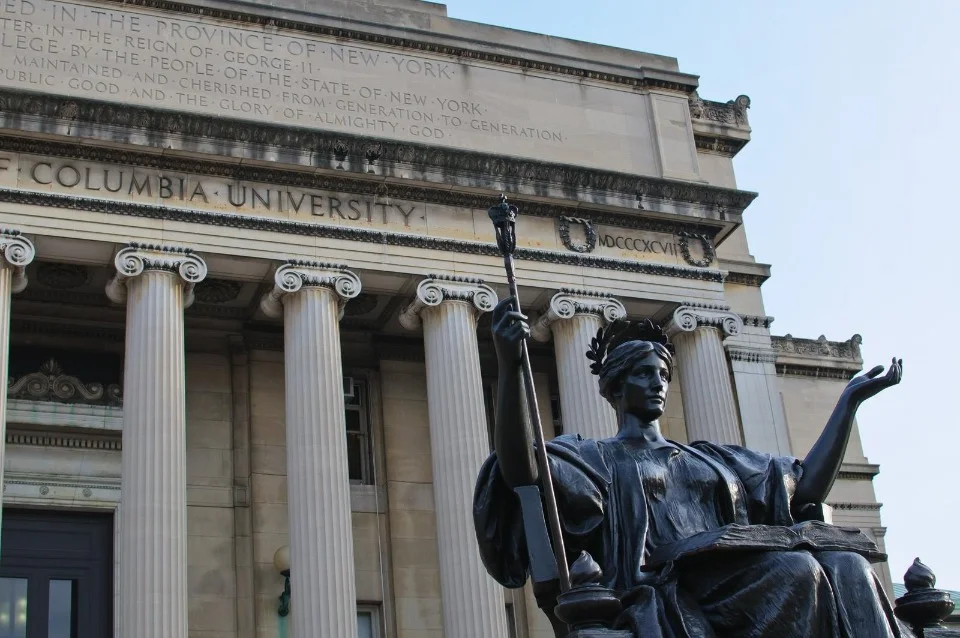
Columbia University, founded in 1754, is one of the oldest and most prestigious universities in the United States, located in New York City. As a member of the Ivy League, Columbia is known for its rigorous academics, distinguished faculty, and vibrant urban campus. The university offers a wide range of programs through its undergraduate Columbia College and renowned graduate schools, including Journalism, Law, and Business. Columbia's libraries and research centers are among the best in the world, supporting cutting-edge scholarship. Ranked consistently among the top global universities, Columbia excels in fields like humanities, social sciences, and engineering.
Columbia's location in Manhattan provides students with unparalleled access to internships, cultural institutions, and professional networks. The university fosters a diverse and inclusive community, attracting students from over 100 countries. Columbia's Core Curriculum emphasizes critical thinking and intellectual exploration, shaping well-rounded graduates. The campus blends historic architecture with modern facilities, offering state-of-the-art labs and collaborative spaces. Columbia's commitment to public service is evident in its community engagement programs and research initiatives. Alumni include U.S. presidents, Nobel laureates, and leaders in every field, underscoring the university's global impact.
With a 4.2% acceptance rate, Columbia University in the City of New York sits firmly in the elite tier of US admissions. Only 4 in 100 applicants are offered a seat.

At this tier, meeting the average GPA and test scores is the baseline, not the differentiator. Your essays and recommendations are what separate you from the rest of an already-strong pool.
Source: IPEDS & College Scorecard (Nov 2025).
The application deadline for Columbia University in the City of New York is November 1 for Early Decision applicants, with additional plans listed below. Admission decisions are typically released by December 15.
💡 The scholarship deadline (Financial aid priority: 2025/11/15) often falls before the regular admission deadline. Submit your application and FAFSA early to be considered for maximum aid.
Deadlines are verified from official institutional sources but may change each cycle. Always confirm final dates on the official website.
The average GPA of admitted students at Columbia University is 3.91. That makes admissions here extremely selective. Most admitted students carry straight A's, with very little room for a B.
If your GPA sits between 3.61 and 3.91, a high SAT or ACT score is the most reliable way to compensate.
Most schools report GPA on a weighted or unweighted 4.0 scale differently. For an unweighted profile like this, students with AP/IB coursework typically carry a weighted GPA of 4.11–4.31.Assessment: Extreme selectivity; requires elite academic standing.
Recommended Strategy: High Course Rigor (AP/IB/Honors) to validate the grade.
Where your GPA falls in this range shapes what the rest of your application needs to do:
Data verified via IPEDS, College Scorecard (Nov 2025) and the Common Data Set (CDS). Expert Review led by Sohaib Khan and Dr. Waseem.
Real-Time Sensitive Analysis — based on Columbia University in the City of New York's verified institutional data
Adjust the sliders to see how every decimal point affects your outcome.
✅ Verified Data: Institutional records for 2026.
Calculated via College Portal's Human-Intelligence (HI) Methodology & Editorial Standards. Verified by Sohaib Ahmad Khan.
Standardized scores still matter here: aim for the middle 50% range of the 2026 admitted class below, and if Columbia University is test-optional, a high score submitted voluntarily still helps with merit scholarships.
The average SAT score of admitted students at Columbia University in the City of New York is 1547 on the 1600-point scale.
This places Columbia University in the top tier nationally for SAT scores. It sits well above the 75th percentile of all US test-takers.
If your score is below 1490, retaking the SAT is strongly recommended to improve your chances at Columbia University. Retaking multiple times is completely normal. Most competitive applicants sit for it two or three times. There's no official limit on attempts.
| Section | Average | 25th Percentile | 75th Percentile |
|---|---|---|---|
| SAT Math | 780 | 760 | 800 |
| SAT Reading | 750 | 730 | 770 |
| SAT Composite | 1547 | 1490 | 1570 |
Below 1490, you're behind most admitted students; at 1570 or above, you're ahead of 75% of them. (25th/75th percentile = the score below which that share of admitted students fall.)
View list of all colleges with average SAT score of 1550
A 1550 SAT puts you ahead of most of Columbia University's admitted class, but admissions still weighs GPA, course rigor, and essays alongside it. A strong score opens the door; the rest of your profile decides what happens next.
The average ACT score at Columbia University is 35.
An average of 35 places Columbia University among the most ACT-competitive schools nationally.
| Section | Average | 25th Percentile | 75th Percentile |
|---|---|---|---|
| ACT Math | 34 | 32 | 35 |
| ACT English | 36 | 35 | 36 |
| ACT Composite | 35 | 34 | 35 |
A 35 ACT puts you ahead of 75% of Columbia University's admitted students. That's a strong position, though the ACT is only one benchmark among several that admissions weighs.
Unlike the SAT, the ACT scores four separate sections: English, Math, Reading, and Science, each on a 1–36 scale. A noticeably weak section, especially Science at STEM-focused schools, stands out to reviewers, so it's worth checking your section breakdown for outliers before applying.
Your ACT score clears the first filter, but GPA, course rigor, extracurricular depth, recommendations, and essays are what carry an application the rest of the way at Columbia University.
Columbia University isn't looking for well-rounded applicants. It's looking for 'pointy.' The strategy here is to make your one strongest area impossible to overlook.
Columbia's 2025?26 supplement requires one list (100 words, comma/semicolon format - not prose) and six short essays at 150 words each: (1) texts and media that shaped your intellectual development outside class; (2) lived experience and how it shapes your contribution to Columbia's collaborative environment; (3) a time you disagreed with someone and engaged across difference; (4) a barrier or obstacle you faced and how it shaped you; (5) why you want to attend Columbia; (6) why your intended major (Columbia College version vs. SEAS version differ). At 150 words per response, every essay must open on the answer, not the wind-up. The list prompt carries more weight than students assume - submitting prose rather than the required comma/semicolon format is a formatting failure that signals non-compliance with explicit instructions.
Prompt 5 is Columbia's direct fit essay: "Why are you interested in attending Columbia University? We encourage you to consider the aspect(s) that you find unique and compelling about Columbia." The essays that fail name the Core Curriculum and New York City without connecting either to something specific in the student's life. The version that succeeds names a specific Core text (Contemporary Civilization, Literature Humanities, Art Humanities, Music Humanities) and explains why wrestling with that particular tradition of thought connects to the student's formed intellectual habits - then adds one concrete Columbia-specific outcome: a research center, a student organization, a dual-degree pathway (Sciences Po, Trinity College Dublin), or an Urban Studies or concentration unique to Columbia. At 150 words this essay should be nearly impossible to repurpose for another school.
Columbia explicitly instructs applicants to respond to the reading/media list with items separated by commas or semicolons - no annotations, no author names, no explanatory remarks. Students who write prose paragraphs explaining each item have failed to follow directions. The list itself is evaluated for intellectual range and honesty: a list consisting entirely of canonical high-school-syllabus titles reads as curated for impression rather than authentic engagement. The strongest lists span disciplines, include at least one item that no algorithm would suggest, and hold together as the genuine intellectual diet of one particular person. This prompt is Columbia's first test of whether you think the way the Core Curriculum requires - across traditions, not just deeply within one.
Columbia's Early Decision is binding. ED acceptance rates are estimated at approximately 11?13% versus roughly 3.4% Regular Decision for the Class of 2030 - a ratio of roughly three to four times higher. ED applications have declined two consecutive cycles, so the pool is more self-selected and potentially more competitive per-seat than the raw rate suggests. Columbia is need-blind for U.S. domestic applicants and meets 100% of demonstrated need without loans; families earning under $150,000 with typical assets pay no tuition, room, or board. Running Columbia's Net Price Calculator before committing to binding ED is essential - the financial package won't be known until after commitment, and the binding agreement has teeth.
Columbia does not conduct admissions interviews ("Not Considered" in their CDS), which means the six supplemental essays collectively carry the full weight of the personal impression. Unlike most Ivies, there is no interview that can correct a weak essay set or add missing context. A student who writes six essays that all illuminate the same trait or the same domain of interest - for example, six responses all gesturing at academic research - has presented a one-dimensional portrait with no opportunity for correction. Before drafting anything, students should map which aspect of their character each of the six responses will reveal, ensuring they create genuine differentiation across the full supplement. The essays were designed as windows, not mirrors.
At $86,042/year against a $102,491 median graduate salary, Columbia University is worth weighing against your specific program and financial situation. The numbers below give you a real basis for that decision.
The average household income among admitted students is $77,000, with a graduate unemployment rate of 3.67%.
The sticker price is $86,042/year, but the average net price students actually pay, after Pell and federal grants, is typically much lower.
22.5% of students receive a Pell Grant and 14.4% take federal loans at Columbia University. File your FAFSA early and list Columbia University as a choice to be considered for both.
Median earnings 10 years after enrollment (roughly 4–6 years post-graduation) are $102,491. That's about 152% above the U.S. median graduate income.

These schools have lower average SAT or ACT scores than Columbia University in the City of New York. If your SAT or ACT score is slightly lower, you'll be competitive for these schools.
| School | Location | SAT | ACT |
|---|---|---|---|
| Claremont McKenna College | Claremont, CA | 1514 | 34 |
| Harvey Mudd College | Claremont, CA | 1537 | 35 |
| Pomona College | Claremont, CA | 1520 | 34 |
| University of Southern California | Los Angeles, CA | 1501 | 34 |
| Wesleyan University | Middletown, CT | 1513 | 34 |
| Yale University | New Haven, CT | 1534 | 34 |
| Emory University | Atlanta, GA | 1507 | 33 |
| Northwestern University | Evanston, IL | 1526 | 34 |
| University of Notre Dame | Notre Dame, IN | 1510 | 34 |
| Bowdoin College | Brunswick, ME | 1514 | 34 |

These schools have the same range of average SAT or ACT scores as Columbia University in the City of New York. If your SAT or ACT score is competitive, you'll be competitive for these schools also.
| School | Location | SAT | ACT |
|---|---|---|---|
| Harvey Mudd College | Claremont, CA | 1537 | 35 |
| University of Chicago | Chicago, IL | 1554 | 35 |
| Johns Hopkins University | Baltimore, MD | 1553 | 35 |
| Harvard University | Cambridge, MA | 1553 | 35 |
| Massachusetts Institute of Technology | Cambridge, MA | 1553 | 35 |
Columbia University in the City of New York graduates typically earn around $102,491 a year, on the higher end depending on industry.
At about $86,042 a year, Columbia University in the City of New York's cost is on the higher end; look closely at aid options.
Columbia University in the City of New York's Pell Grant rate of 22.5% sits below the national average. Merit-based aid is worth checking regardless of income.
At 4.2%, Columbia University in the City of New York admits a very small share of applicants. This is elite-tier selectivity.
Admitted students at Columbia University in the City of New York average a 3.91 GPA.
Columbia University in the City of New York doesn't publish a hard GPA floor, but landing at or above 3.61 keeps you in the typical applicant range; below it, lean on essays and recommendations.
Below 3.51, Columbia University in the City of New York becomes a harder reach, though a strong test score, meaningful activities, and AP/IB coursework can still make a real case.
A strong SAT score matters at Columbia University in the City of New York — aim above 1547, ideally within the 1490–1570 range admitted students typically fall in.
The application deadline for Columbia University in the City of New York is November 1 for Early Decision applicants. Admission decisions are released by December 15.
The application fee is 85. Fee waivers may be available. Check with admissions.
The scholarship/financial aid priority deadline is Financial aid priority: 2025/11/15. Submit FAFSA before then for maximum consideration.
Yes, transfers are common. Have transcripts, recommendation letters, and a solid personal statement ready to make your case.
Strong academics, a focused extracurricular profile, and standout essays move the needle most, along with a competitive SAT/ACT score where relevant.