
Non-Profit Private
Accredited · New England Commission on Higher Education
New Haven, Connecticut
4.5% Acceptance Rate
A complete at-a-glance picture of every metric that matters for your 2026 application
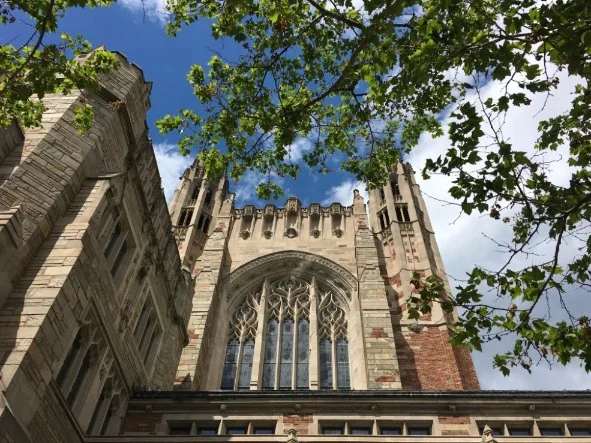
Yale University, founded in 1701, is one of the oldest and most prestigious institutions in the United States, known for its excellence in liberal arts education. Located in New Haven, Connecticut, Yale's historic campus features Gothic architecture, world-class libraries, and state-of-the-art research facilities. The university offers a broad range of programs through Yale College and its renowned graduate and professional schools, including Law, Medicine, and Drama. Yale's faculty includes leading scholars, artists, and scientists, fostering a dynamic intellectual environment. Ranked among the top universities globally, Yale is particularly strong in humanities, social sciences, and law.
Yale's commitment to undergraduate education is reflected in its residential college system, which creates tight-knit communities within the larger university. The Yale Art Gallery and Peabody Museum provide students with unique cultural and research resources. Yale's financial aid policies ensure that students from all economic backgrounds can access its world-class education. The university's global initiatives, such as the Yale World Fellows program, emphasize leadership and cross-cultural understanding. Alumni include U.S. presidents, Supreme Court justices, and Nobel laureates, underscoring Yale's enduring influence. Its blend of tradition and innovation continues to attract the brightest minds worldwide.
Yale University accepted just 4.5% of applicants last cycle, roughly 5 out of every 100 who applied, placing it among the most selective schools among colleges in Connecticut.

At this tier, meeting the average GPA and test scores is the baseline, not the differentiator. Your essays and recommendations are what separate you from the rest of an already-strong pool.
Source: IPEDS & College Scorecard (Nov 2025).
The application deadline for Yale University is November 1 for Single-Choice Early Action applicants, with additional plans listed below. Admission decisions are typically released by December 15.
💡 The scholarship deadline (March 1, 2026) often falls before the regular admission deadline. Submit your application and FAFSA early to be considered for maximum aid.
Deadlines are verified from official institutional sources but may change each cycle. Always confirm final dates on the official website.
The average GPA of admitted students at Yale University is 3.95. That makes admissions here extremely selective. Most admitted students carry straight A's, with very little room for a B.
If your GPA sits between 3.65 and 3.95, a high SAT or ACT score is the most reliable way to compensate.
Most schools report GPA on a weighted or unweighted 4.0 scale differently. For an unweighted profile like this, students with AP/IB coursework typically carry a weighted GPA of 4.15–4.35.Assessment: Extreme selectivity; requires elite academic standing.
Recommended Strategy: High Course Rigor (AP/IB/Honors) to validate the grade.
Where your GPA falls in this range shapes what the rest of your application needs to do:
Data verified via IPEDS, College Scorecard (Nov 2025) and the Common Data Set (CDS). Expert Review led by Sohaib Khan and Dr. Waseem.
Real-Time Sensitive Analysis — based on Yale University's verified institutional data
Adjust the sliders to see how every decimal point affects your outcome.
✅ Verified Data: Institutional records for 2026.
Calculated via College Portal's Human-Intelligence (HI) Methodology & Editorial Standards. Verified by Sohaib Ahmad Khan.
Standardized scores still matter here: aim for the middle 50% range of the 2026 admitted class below, and if Yale University is test-optional, a high score submitted voluntarily still helps with merit scholarships.
The average SAT score of admitted students at Yale University is 1534 on the 1600-point scale.
This places Yale University in the top tier nationally for SAT scores. It sits well above the 75th percentile of all US test-takers.
If your score is below 1500, retaking the SAT is strongly recommended to improve your chances at Yale University. Retaking multiple times is completely normal. Most competitive applicants sit for it two or three times. There's no official limit on attempts.
| Section | Average | 25th Percentile | 75th Percentile |
|---|---|---|---|
| SAT Math | 780 | 760 | 800 |
| SAT Reading | 760 | 740 | 780 |
| SAT Composite | 1534 | 1500 | 1580 |
Below 1500, you're behind most admitted students; at 1580 or above, you're ahead of 75% of them. (25th/75th percentile = the score below which that share of admitted students fall.)
View list of all colleges with average SAT score of 1550
A 1600 SAT puts you ahead of most of Yale University's admitted class, but admissions still weighs GPA, course rigor, and essays alongside it. A strong score opens the door; the rest of your profile decides what happens next.
The average ACT score at Yale University is 34.
An average of 34 places Yale University among the most ACT-competitive schools nationally.
| Section | Average | 25th Percentile | 75th Percentile |
|---|---|---|---|
| ACT Math | 33 | 31 | 35 |
| ACT English | 35 | 34 | 36 |
| ACT Composite | 34 | 33 | 35 |
A 35 ACT puts you ahead of 75% of Yale University's admitted students. That's a strong position, though the ACT is only one benchmark among several that admissions weighs.
Unlike the SAT, the ACT scores four separate sections: English, Math, Reading, and Science, each on a 1–36 scale. A noticeably weak section, especially Science at STEM-focused schools, stands out to reviewers, so it's worth checking your section breakdown for outliers before applying.
Your ACT score clears the first filter, but GPA, course rigor, extracurricular depth, recommendations, and essays are what carry an application the rest of the way at Yale University.
To succeed at a world-class institution like Yale University, move beyond 'well-rounded' and show you're institutionally necessary, with a specific, undeniable strength rather than a broad set of decent ones.
Yale's supplement asks you to go deep on a single idea, object, or experience rather than survey your whole r?sum?. Choose one specific moment - a conversation, a failure, a strange obsession - and mine it for what it reveals about how your mind works. Yale's readers have seen thousands of "well-rounded" narratives; they're searching for one sharply rendered point of view, not a highlight reel.
Apply REA only if Yale is unambiguously your first choice - Yale's own admissions office says early applicants get no edge in how they're scored, so the higher early-round admit rate reflects a stronger applicant pool, not lenient readers. If you apply REA, you forfeit Early Decision elsewhere and Early Action at other private universities, so treat the November 1 deadline as a forcing function to have your strongest self on paper four months sooner, not a strategic loophole.
Yale's identity is built around its twelve residential colleges - small, self-contained communities where students eat, live, and govern together for four years. Use your "Why Yale" response to name what kind of community member you'd be inside that structure (a seminar debater, a late-night common-room organizer, an intramural team captain) rather than listing Yale's rankings or general prestige, which signals you haven't engaged with what actually makes Yale distinct.
With roughly 1 in 20 applicants admitted, Yale's committee is explicitly trained to discount scattered, joined-everything r?sum?s in favor of sustained, escalating commitment in two or three areas. Show a multi-year arc - founding something, being promoted, producing measurable outcomes - rather than a long list of club memberships with no depth, since Yale's holistic readers are pattern-matching for genuine intellectual or creative obsession, not joiner behavior.
Whether Yale University is worth it depends less on its reputation and more on your program choice, financial aid package, and career goals. Here's the data to weigh it against.
The average household income among admitted students is $75,300, with a graduate unemployment rate of 3.53%.
The sticker price is $85,120/year, but the average net price students actually pay, after Pell and federal grants, is typically much lower.
19.2% of students receive a Pell Grant and 5.8% take federal loans at Yale University. File your FAFSA early and list Yale University as a choice to be considered for both.
Median earnings 10 years after enrollment (roughly 4–6 years post-graduation) are $100,533. That's about 148% above the U.S. median graduate income.

These schools have lower average SAT or ACT scores than Yale University. If your SAT or ACT score is slightly lower, you'll be competitive for these schools.
| School | Location | SAT | ACT |
|---|---|---|---|
| Claremont McKenna College | Claremont, CA | 1514 | 34 |
| Pomona College | Claremont, CA | 1520 | 34 |
| University of Southern California | Los Angeles, CA | 1501 | 34 |
| Wesleyan University | Middletown, CT | 1513 | 34 |
| Georgetown University | Washington, DC | 1494 | 33 |
| Emory University | Atlanta, GA | 1507 | 33 |
| University of Notre Dame | Notre Dame, IN | 1510 | 34 |
| Grinnell College | Grinnell, IA | 1486 | 33 |
| Bowdoin College | Brunswick, ME | 1514 | 34 |
| Colby College | Waterville, ME | 1500 | 33 |

These schools have the same range of average SAT or ACT scores as Yale University. If your SAT or ACT score is competitive, you'll be competitive for these schools also.
| School | Location | SAT | ACT |
|---|---|---|---|
| Harvey Mudd College | Claremont, CA | 1537 | 35 |
| Northwestern University | Evanston, IL | 1526 | 34 |
| Williams College | Williamstown, MA | 1527 | 34 |
| Washington University in St Louis | St. Louis, MO | 1530 | 34 |
| Dartmouth College | Hanover, NH | 1533 | 34 |
Yale University graduates typically earn around $100,533 a year, on the higher end depending on industry.
At about $85,120 a year, Yale University's cost is on the higher end; look closely at aid options.
Yale University's Pell Grant rate of 19.2% sits below the national average. Merit-based aid is worth checking regardless of income.
At 4.5%, Yale University admits a very small share of applicants. This is elite-tier selectivity.
Admitted students at Yale University average a 3.95 GPA.
Yale University doesn't publish a hard GPA floor, but landing at or above 3.65 keeps you in the typical applicant range; below it, lean on essays and recommendations.
Below 3.55, Yale University becomes a harder reach, though a strong test score, meaningful activities, and AP/IB coursework can still make a real case.
A strong SAT score matters at Yale University — aim above 1534, ideally within the 1500–1580 range admitted students typically fall in.
The application deadline for Yale University is November 1 for Single-Choice Early Action applicants. Admission decisions are released by December 15.
The application fee is 80. Fee waivers may be available. Check with admissions.
The scholarship/financial aid priority deadline is March 1, 2026. Submit FAFSA before then for maximum consideration.
Yes, transfers are common. Have transcripts, recommendation letters, and a solid personal statement ready to make your case.
Strong academics, a focused extracurricular profile, and standout essays move the needle most, along with a competitive SAT/ACT score where relevant.