
Public
Accredited · Southern Association of Colleges and Schools Commission on Colleges
Tallahassee, Florida
A complete at-a-glance picture of every metric that matters for your 2026 application
Tallahassee State College FL Tallahassee State College serves as a major educational gateway for students planning to transfer to Florida universities or enter the workforce through career-focused programs. Its proximity to major universities and state government institutions provides unique academic and professional opportunities.\n\nThe college is known for strong transfer pathways, affordable tuition, and programs in healthcare, business, public service, and technology. Students seeking flexibility, affordability, and university transfer preparation often consider TSC an excellent starting point.
Tallahassee State College runs an open-access admission policy. With a 100% acceptance rate, the focus is on getting qualified students in, not filtering them out.

Slightly below-average GPA? A strong test score or clear leadership track record can still keep you competitive.
Source: IPEDS & College Scorecard (Nov 2025).
Tallahassee State College follows a Rolling Admissions policy, meaning applications are reviewed as they arrive and there is no single fixed deadline.
Tallahassee State College reviews applications continuously throughout the year. Seats and scholarships are awarded on a first-come, first-served basis, so applying early gives you a significant advantage for both admission and financial aid.
Deadlines are verified from official institutional sources but may change each cycle. Always confirm final dates on the official website.
Real-Time Sensitive Analysis — based on Tallahassee State College's verified institutional data
Adjust the sliders to see how every decimal point affects your outcome.
⚠️ Note: Predicting based on regional averages as this institution does not publicly report full score datasets.
Calculated via College Portal's Human-Intelligence (HI) Methodology & Editorial Standards. Verified by Sohaib Ahmad Khan.
Standardized scores still matter here: aim for the middle 50% range of the 2026 admitted class below, and if Tallahassee State College is test-optional, a high score submitted voluntarily still helps with merit scholarships.
Tallahassee State College's open-access model means the real strategic decisions happen after enrollment: course planning, advising, and whether to transfer later.
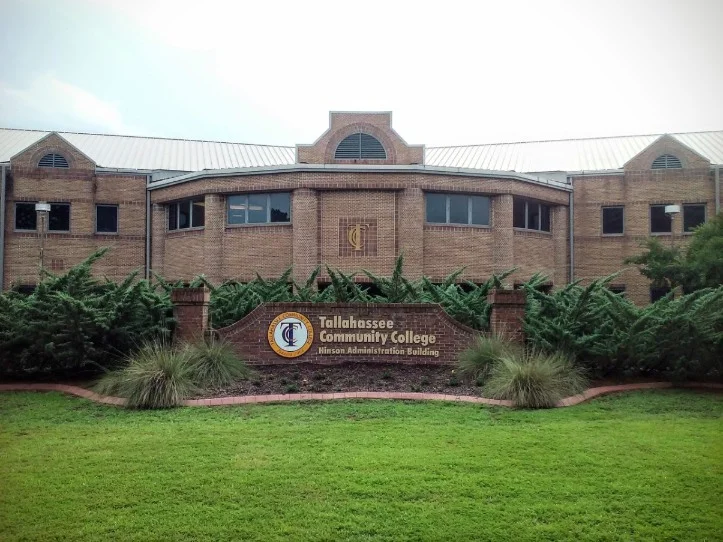
Effective July 1, 2024, under Florida Senate Bill 522, Tallahassee Community College (TCC) officially became Tallahassee State College (TSC). This was not a cosmetic rebrand - it accompanied the college's addition of three new bachelor's degrees and reflected its evolving institutional status as one of Florida's last community colleges to retain "community" in its name after most peer institutions dropped it upon gaining bachelor's-degree authority. The practical implication for counselors: a significant volume of older web content, guidebooks, forum posts, and even some outdated counseling resources still reference "Tallahassee Community College" or "TCC." Students researching this institution should be redirected to confirm they are looking at current (TSC) information, since program offerings, the bachelor's degree slate, and the rebrand-related facility investments are all recent enough that pre-2024 information may be stale. The UNITID (137759) has remained constant through the name change, so institutional research databases correctly track this as a single continuous institution.
TSC holds a structurally rare distinction: it is simultaneously the top transfer feeder institution to both Florida State University (a flagship PWI) and Florida A&M University (the state's public HBCU) - two universities with very different institutional cultures located in the same city as TSC. TSC has formalized this dual relationship through named transfer programs: Aspire is the structured pathway to FSU, and IGNITE is the structured pathway to FAMU. Both programs go beyond the general Florida 2+2 AA transfer guarantee (which applies to all 12 SUS institutions) by providing institution-specific advising, embedded FSU or FAMU campus access, and admission counseling tailored to each university's specific application requirements and culture. For Tallahassee-area students choosing between FSU and FAMU as a transfer destination, identifying which named pathway applies and engaging with that program's specific advisors - rather than treating both as generic AA-to-university transfers - is the structurally correct first move.
TSC's Florida Public Safety Institute, housing the Pat Thomas Law Enforcement Academy and the Tallahassee Fire Academy, operates on roughly 1,500 acres of dedicated training land in Gadsden County near Havana, Florida - acreage TSC began acquiring in 2003 specifically to build out large-scale, realistic training environments for law enforcement and fire/EMT cadets. This is a structurally unusual asset for a Florida College System institution: most public safety academies operate as smaller programs within a shared campus, not as a dedicated, expansive training complex. For students pursuing criminal justice, law enforcement, or fire/EMS careers, TSC's Public Safety Institute offers training realism (and a built environment for tactical, driving, and fire simulation training) that smaller programs elsewhere in Florida cannot replicate. Students interested in these career tracks should contact the Institute directly, as the Public Safety Institute's admissions and training cycle calendar runs separately from TSC's general academic calendar.
TSC offers four bachelor's degrees: a Bachelor of Science in Nursing (the original bachelor's program, added in 2014), and three newer additions - Bachelor of Applied Science in Business Administration, Bachelor of Science in Elementary Education, and Bachelor of Science in Exceptional Student Education (special education). Coursework descriptions emphasize practical Program Learning Outcomes - financial/economic decision-making and leadership for the business degree, applied research and learning theory for elementary education - and these are full four-year credentials earned at community college tuition rates, regionally accredited (SACSCOC) the same as TSC's associate programs. For students who know they want a career in nursing, business leadership, elementary teaching, or special education, and who want to avoid the cost of attending FSU or FAMU directly, TSC's bachelor's track is a legitimate, lower-cost alternative - but students should run a side-by-side cost comparison against the Aspire/IGNITE transfer pathways before committing, since transfer to FSU or FAMU after an AA may unlock different scholarship and program access that the TSC bachelor's track does not.
The most consistently overlooked risk at TSC involves students and families who research the institution using its former name and encounter outdated program lists, transfer agreement summaries, or admissions process descriptions from before the July 2024 rebrand and the addition of the Business and Education bachelor's degrees. Because TSC retained the same UNITID and physical campus through the name change, search results and even some institutional research databases blend old TCC content with current TSC content without clearly distinguishing what has changed. A second, distinct failure pattern: students who assume the Florida AA-to-university guarantee means equivalent treatment regardless of whether they pursue FSU through Aspire or FAMU through IGNITE - when in practice these are two separately branded, separately staffed advising relationships with different campus cultures, application nuances, and program access points. Treating "transfer to a Tallahassee university" as a single undifferentiated goal, rather than choosing and engaging the specific named pathway program, weakens a student's positioning at either destination.
Whether Tallahassee State College is worth it depends less on its reputation and more on your program choice, financial aid package, and career goals. Here's the data to weigh it against.
The average household income among admitted students is $51,000, with a graduate unemployment rate of 5.1%.
The sticker price is $13,188/year, but the average net price students actually pay, after Pell and federal grants, is closer to $8,478.
37% of students receive a Pell Grant and 47.9% take federal loans at Tallahassee State College. File your FAFSA early and list Tallahassee State College as a choice to be considered for both.
Median earnings 10 years after enrollment (roughly 4–6 years post-graduation) are $37,561. That's somewhat below the U.S. median graduate income of $40,595.
Median earnings for Tallahassee State College graduates sit around $37,561 a year.
At about $13,188 a year, Tallahassee State College is on the more affordable end.
About 37.0% receive a Pell Grant at Tallahassee State College. The odds are moderate and largely income-dependent, but an early FAFSA filing still helps.
Tallahassee State College follows Rolling Admissions. Applications are reviewed year-round, so applying early is your best strategy.
Yes, transfers are common. Have transcripts, recommendation letters, and a solid personal statement ready to make your case.
Strong academics, a focused extracurricular profile, and standout essays move the needle most, along with a competitive SAT/ACT score where relevant.