
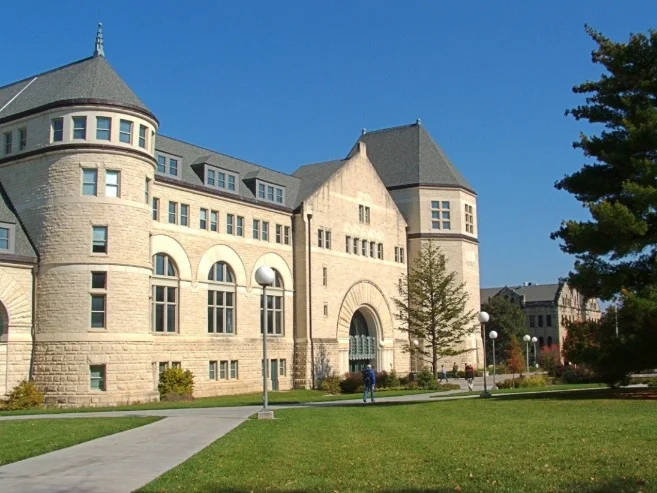
Public
Accredited · Higher Learning Commission
Manhattan, Kansas
79.4% Acceptance Rate
A complete at-a-glance picture of every metric that matters for your 2026 application
Kansas State University is a prestigious public research university known for its commitment to academic excellence, innovation, and service. Offering a comprehensive range of undergraduate and graduate degree programs, the university fosters a vibrant campus community that encourages research, professional development, and community engagement. Its extensive alumni network, state-of-the-art facilities, and reputation for excellence make it a top-tier choice for students seeking a transformative and world-class educational experience.
Kansas State University (K-State) runs an open-access admission policy. With a 79.4% acceptance rate, the focus is on getting qualified students in, not filtering them out.

Source: IPEDS & College Scorecard (Nov 2025).
The average GPA of admitted students at K-State is 3.77. That makes admissions here highly selective. Most admitted students carry mostly A's with the occasional B.
Between 3.47 and 3.77? A strong standardized test score is worth prioritizing.
Most schools report GPA on a weighted or unweighted 4.0 scale differently. For an unweighted profile like this, students with AP/IB coursework typically carry a weighted GPA of 3.97–4.17.Assessment: Highly selective; GPA is within the typical admitted range.
Recommended Strategy: Standardized Test Scores (SAT/ACT) in the top 5th percentile.
Where your GPA falls in this range shapes what the rest of your application needs to do:
Data verified via IPEDS, College Scorecard (Nov 2025) and the Common Data Set (CDS). Expert Review led by Sohaib Khan and Dr. Waseem.
Real-Time Sensitive Analysis — based on Kansas State University's verified institutional data
Adjust the sliders to see how every decimal point affects your outcome.
✅ Verified Data: Institutional records for 2026.
Calculated via College Portal's Human-Intelligence (HI) Methodology & Editorial Standards. Verified by Sohaib Ahmad Khan.
Standardized scores still matter here: aim for the middle 50% range of the 2026 admitted class below, and if K-State is test-optional, a high score submitted voluntarily still helps with merit scholarships.
The average SAT score of admitted students at Kansas State University is 1149 on the 1600-point scale.

This average is slightly below the national mean SAT score.
If your score is below 1040, retaking the SAT is strongly recommended to improve your chances at K-State. Retaking multiple times is completely normal. Most competitive applicants sit for it two or three times. There's no official limit on attempts.
| Section | Average | 25th Percentile | 75th Percentile |
|---|---|---|---|
| SAT Math | 570 | 510 | 630 |
| SAT Reading | 580 | 530 | 630 |
| SAT Composite | 1149 | 1040 | 1260 |
Below 1040, you're behind most admitted students; at 1260 or above, you're ahead of 75% of them. (25th/75th percentile = the score below which that share of admitted students fall.)
View list of all colleges with average SAT score of 1150
A 1250 SAT puts you ahead of most of K-State's admitted class, but admissions still weighs GPA, course rigor, and essays alongside it. A strong score opens the door; the rest of your profile decides what happens next.
The average ACT score at K-State is 24.

This sits close to the national average ACT score.
| Section | Average | 25th Percentile | 75th Percentile |
|---|---|---|---|
| ACT Math | 23 | 19 | 26 |
| ACT English | 23 | 18 | 27 |
| ACT Composite | 24 | 20 | 27 |
A 27 ACT puts you ahead of 75% of K-State's admitted students. That's a strong position, though the ACT is only one benchmark among several that admissions weighs.
Unlike the SAT, the ACT scores four separate sections: English, Math, Reading, and Science, each on a 1–36 scale. A noticeably weak section, especially Science at STEM-focused schools, stands out to reviewers, so it's worth checking your section breakdown for outliers before applying.
Your ACT score clears the first filter, but GPA, course rigor, extracurricular depth, recommendations, and essays are what carry an application the rest of the way at K-State.
K-State takes a broad view of applicants. Your energy is best spent proving readiness for coursework and maximizing your financial aid package.
Unlike KU's two-tier formula, K-State's assured admission requires just one of two simple bars: a 3.25 weighted/unweighted GPA OR a 21 ACT composite/1060 SAT - no combined index calculation needed. A student who clears either bar alone is assured admission; falling short of both still triggers individual holistic review, and K-State caps "exception" admissions (granted without meeting either bar) at 10% of the total admitted class each year, so a borderline applicant should know they're competing within a genuinely limited exception pool, not a blanket safety net.
K-State's Veterinary College Early Admission Program lets a high school senior with a 29+ composite ACT (including a science sub-score, or an exception allowing a 29+ composite even with a lower science sub-score) apply between Aug. 1 and Feb. 1 of senior year for a reserved DVM seat - contingent on maintaining a 3.3+ GPA in 35 hours of required science prerequisites (which must be completed at K-State) through undergrad. This is dramatically different from the standard VMCAS application most pre-vet students use after their junior year of college; a student set on K-State vet med specifically should apply through this program in high school rather than waiting for the traditional pathway.
Outside the Early Admission track, K-State's College of Veterinary Medicine requires a minimum 2.8 GPA in pre-professional prerequisites and a 2.8 GPA in the last 45 semester hours just to be eligible for an interview - any grade below a C- in a required course is disqualifying, and a D or F at the time of application results in automatic rejection regardless of other strengths. A pre-vet student should treat any single prerequisite grade below a C- as an emergency to address (via retake or replacement with a higher-level course in the same subject) well before applying, not something to offset with strong experience hours.
While K-State's general first-year application requires no essay or letters of recommendation, certain majors (the university explicitly flags this in its own admissions materials) use selective admission criteria beyond the standard GPA/test threshold. A student targeting a specific competitive program should check that program's distinct requirements directly rather than assuming the easy general application reflects the whole university's admission posture.
Acceptance-rate figures for K-State cited across sources range widely (from the low-80s to the mid-90s), and the more reliable planning tool is the assured-admission GPA/test threshold itself - but for vet-med-bound students specifically, the real risk is treating the standard VMCAS application route as the only path in: missing the high-school-senior Early Admission window (Aug. 1-Feb. 1) means defaulting to the far more competitive traditional applicant pool later, with no way to retroactively claim the early-admit seat.
Whether K-State is worth it depends less on its reputation and more on your program choice, financial aid package, and career goals. Here's the data to weigh it against.
The average household income among admitted students is $59,900, with a graduate unemployment rate of 2.58%.
The sticker price is $25,441/year, but the average net price students actually pay, after Pell and federal grants, is closer to $17,883.
19.3% of students receive a Pell Grant and 36.6% take federal loans at K-State. File your FAFSA early and list K-State as a choice to be considered for both.
Median earnings 10 years after enrollment (roughly 4–6 years post-graduation) are $57,262. That's about 41% above the U.S. median graduate income.

These schools have lower average SAT or ACT scores than Kansas State University. If your SAT or ACT score is slightly lower, you'll be competitive for these schools.
| School | Location | SAT | ACT |
|---|---|---|---|
| University of South Alabama | Mobile, AL | 1119 | 23 |
| Tuskegee University | Tuskegee, AL | 1121 | 22 |
| Arkansas State University | Jonesboro, AR | 1119 | 22 |
| University of Central Arkansas | Conway, AR | 1117 | 22 |
| University of La Verne | La Verne, CA | 1116 | 22 |
| University of Colorado Denver/Anschutz Medical Campus | Denver, CO | 1119 | 24 |
| Western Colorado University | Gunnison, CO | 1130 | 25 |
| University of Saint Joseph | West Hartford, CT | 1100 | NA |
| Lynn University | Boca Raton, FL | 1136 | 25 |
| Florida Agricultural and Mechanical University | Tallahassee, FL | 1100 | 22 |

These schools have the same range of average SAT or ACT scores as Kansas State University. If your SAT or ACT score is competitive, you'll be competitive for these schools also.
| School | Location | SAT | ACT |
|---|---|---|---|
| Huntingdon College | Montgomery, AL | 1148 | 23 |
| Azusa Pacific University | Azusa, CA | 1155 | 22 |
| University of Colorado Colorado Springs | Colorado Springs, CO | 1140 | 25 |
| Florida International University | Miami, FL | 1154 | 23 |
| Georgia College & State University | Milledgeville, GA | 1150 | 24 |

These schools have higher average SAT or ACT scores than Kansas State University. If you improve your SAT or ACT score, you'll be competitive for these schools.
| School | Location | SAT | ACT |
|---|---|---|---|
| Birmingham-Southern College | Birmingham, AL | 1197 | 24 |
| University of Mobile | Mobile, AL | 1220 | 24 |
| Samford University | Birmingham, AL | 1203 | 26 |
| Harding University | Searcy, AR | 1187 | 25 |
| John Brown University | Siloam Springs, AR | 1222 | 26 |
Median graduate earnings at Kansas State University run about $57,262 a year.
At about $25,441 a year, Kansas State University is on the more affordable end.
Kansas State University's Pell Grant rate of 19.3% sits below the national average. Merit-based aid is worth checking regardless of income.
At 79.4%, Kansas State University's acceptance rate is on the more attainable end compared to top-tier selective schools.
Admitted students at Kansas State University average a 3.77 GPA.
Kansas State University doesn't publish a hard GPA floor, but landing at or above 3.47 keeps you in the typical applicant range; below it, lean on essays and recommendations.
Below 3.37, Kansas State University becomes a harder reach, though a strong test score, meaningful activities, and AP/IB coursework can still make a real case.
A strong SAT score matters at Kansas State University — aim above 1149, ideally within the 1040–1260 range admitted students typically fall in.
Yes, transfers are common. Have transcripts, recommendation letters, and a solid personal statement ready to make your case.
Strong academics, a focused extracurricular profile, and standout essays move the needle most, along with a competitive SAT/ACT score where relevant.