Public
Accredited · Western Association of Schools and Colleges Senior Colleges and University Commission
La Jolla, California
24.5% Acceptance Rate
A complete at-a-glance picture of every metric that matters for your 2026 application
The University of California, San Diego (UCSD), established in 1960, is a powerhouse of research and innovation located along the Pacific coast. UCSD's six undergraduate colleges provide intimate learning communities within a large research university, with strengths in biological sciences, engineering, and oceanography. The university's Scripps Institution of Oceanography is world-renowned, while its Jacobs School of Engineering and School of Medicine are leaders in their fields. UCSD's striking modern campus features the Geisel Library and cutting-edge facilities like the Qualcomm Institute.
UCSD's research enterprise addresses global challenges from climate change to public health. The university's location in La Jolla provides opportunities for collaboration with tech and biotech industries. UCSD's NCAA Division II athletics and vibrant arts scene, including the Stuart Collection of public art, create a dynamic campus life. Alumni include Nobel laureates, tech pioneers, and leaders in science and medicine who drive innovation worldwide.
The acceptance rate at University of California-San Diego is 24.5%, which puts it squarely in the 'reach for most, match for the well-prepared' category.

UCSD reviews the whole profile, not just grades. A well-crafted personal statement genuinely moves the needle here.
Source: IPEDS & College Scorecard (Nov 2025).
The application deadline for University of California-San Diego is December 1.
Deadlines are verified from official institutional sources but may change each cycle. Always confirm final dates on the official website.
The average GPA of admitted students at UCSD is 3.82. That makes admissions here extremely selective. Most admitted students carry straight A's, with very little room for a B.
If your GPA sits between 3.52 and 3.82, a high SAT or ACT score is the most reliable way to compensate.
Most schools report GPA on a weighted or unweighted 4.0 scale differently. For an unweighted profile like this, students with AP/IB coursework typically carry a weighted GPA of 4.02–4.22.Assessment: Highly selective; GPA is within the typical admitted range.
Recommended Strategy: Standardized Test Scores (SAT/ACT) in the top 5th percentile.
Where your GPA falls in this range shapes what the rest of your application needs to do:
Data verified via IPEDS, College Scorecard (Nov 2025) and the Common Data Set (CDS). Expert Review led by Sohaib Khan and Dr. Waseem.
Real-Time Sensitive Analysis — based on University of California-San Diego's verified institutional data
Adjust the sliders to see how every decimal point affects your outcome.
✅ Verified Data: Institutional records for 2026.
Calculated via College Portal's Human-Intelligence (HI) Methodology & Editorial Standards. Verified by Sohaib Ahmad Khan.
Standardized scores still matter here: aim for the middle 50% range of the 2026 admitted class below, and if UCSD is test-optional, a high score submitted voluntarily still helps with merit scholarships.
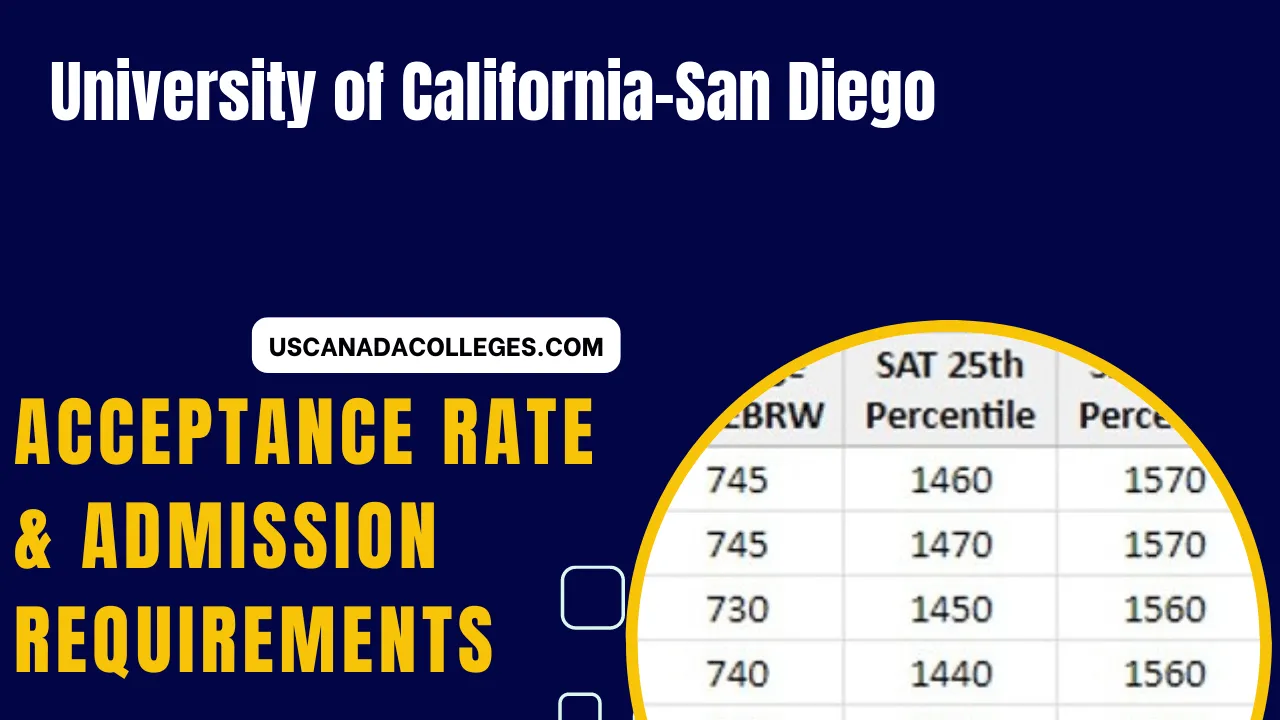
The average SAT score of admitted students at University of California-San Diego is 1375 on the 1600-point scale.

This average is solidly above the national mean, without being in elite-tier territory.
If your score is below 1335, retaking the SAT is strongly recommended to improve your chances at UCSD. Retaking multiple times is completely normal. Most competitive applicants sit for it two or three times. There's no official limit on attempts.
| Section | Average | 25th Percentile | 75th Percentile |
|---|---|---|---|
| SAT Math | - | - | - |
| SAT Reading | - | - | - |
| SAT Composite | 1375 | 1335 | 1405 |
Below 1335, you're behind most admitted students; at 1405 or above, you're ahead of 75% of them. (25th/75th percentile = the score below which that share of admitted students fall.)
View list of all colleges with average SAT score of 1400
A 1400 SAT puts you ahead of most of UCSD's admitted class, but admissions still weighs GPA, course rigor, and essays alongside it. A strong score opens the door; the rest of your profile decides what happens next.
UCSD rewards consistency. Being a top-quartile applicant here doesn't just help admission odds. It's usually what unlocks the strongest scholarship offers too.
UC San Diego's admissions landscape has transformed completely over the past decade: 100% of admitted students now come from the top 10% of their high school class, and the average admitted GPA exceeds 4.0. The school is fully test-blind, meaning your A-G coursework grades - particularly in 10th and 11th grade - carry the entire academic weight of your application. Rigor relative to what your school offers matters as much as raw GPA: a student who takes every AP, honors, and IB course available at their school is viewed more favorably than a student with the same GPA who avoided challenge. For STEM-focused applicants, especially those targeting Computer Science Engineering, Bioengineering, or Data Science, the academic baseline is even higher - these are among the most competitive programs in the entire UC system.
UCSD admits students to specific majors, and the variation in competitiveness between programs is enormous. Engineering programs - particularly Computer Science Engineering and Bioengineering - are capped and cannot be switched into after admission, making your initial major declaration a high-stakes decision. If your first-choice major is one of UCSD's most impacted programs, selecting a strategic alternate major in a less competitive school or division can meaningfully protect your admission pathway. Pre-medical students in particular should consider that pursuing a non-capped major in the humanities or social sciences can actually produce better outcomes: medical schools don't prefer science majors, and a higher GPA in an uncapped program combined with completed science prerequisites is a stronger medical school application than a deflated GPA in a capped STEM major.
UC San Diego does not require any supplemental essays beyond the standard UC Personal Insight Questions - which means your four PIQ responses (350 words each, chosen from eight prompts) carry the entire narrative weight of your application beyond the transcript. UCSD's admissions officers explicitly look for specific and personal responses that showcase unique experiences and perspectives. Do not choose prompts that seem most impressive on paper; choose the four that allow you to write with the most specificity and honesty. Quantify the impact of your activities where possible - describe exactly what changed because of your leadership, research, or community involvement. UCSD values depth: a student who can articulate a single profound experience with precision and authenticity will consistently outperform a student who name-drops a list of accomplishments without genuine reflection.
A distinctive and often overlooked element of the UCSD application is the requirement to rank all six residential colleges - Revelle, Muir, Marshall, Warren, Roosevelt, and Sixth - in order of preference. Each college has a distinct general education philosophy, community culture, and academic requirements. This ranking affects your housing, advising, and core curriculum experience for your entire undergraduate career, and UCSD does use your rankings in the placement process. Research each college's general education requirements before you rank them: Revelle is the most rigorous and scientifically intensive, while Muir offers the most flexibility. Students who rank colleges thoughtfully - matching them to their academic interests and learning style - are also better positioned to write compelling PIQ essays that reference UCSD-specific program and community details.
At $36,325/year against a $84,943 median graduate salary, UCSD is worth weighing against your specific program and financial situation. The numbers below give you a real basis for that decision.
The average household income among admitted students is $76,400, with a graduate unemployment rate of 3.65%.
The sticker price is $36,325/year, but the average net price students actually pay, after Pell and federal grants, is closer to $11,750.
32.9% of students receive a Pell Grant and 24.1% take federal loans at UCSD. File your FAFSA early and list UCSD as a choice to be considered for both.
Median earnings 10 years after enrollment (roughly 4–6 years post-graduation) are $84,943. That's about 109% above the U.S. median graduate income.

These schools have lower average SAT or ACT scores than University of California-San Diego. If your SAT or ACT score is slightly lower, you'll be competitive for these schools.
| School | Location | SAT | ACT |
|---|---|---|---|
| Hendrix College | Conway, AR | 1336 | 29 |
| Chapman University | Orange, CA | 1353 | 30 |
| University of Colorado Boulder | Boulder, CO | 1353 | 31 |
| University of Denver | Denver, CO | 1344 | 31 |
| United States Air Force Academy | USAF Academy, CO | 1362 | 30 |
| University of Connecticut | Storrs, CT | 1338 | 31 |
| Wheaton College | Wheaton, IL | 1363 | 30 |
| Centre College | Danville, KY | 1345 | 29 |
| Bentley University | Waltham, MA | 1340 | 31 |
| Clark University | Worcester, MA | 1339 | 32 |

These schools have the same range of average SAT or ACT scores as University of California-San Diego. If your SAT or ACT score is competitive, you'll be competitive for these schools also.
| School | Location | SAT | ACT |
|---|---|---|---|
| Pepperdine University | Malibu, CA | 1367 | 29 |
| Westmont College | Santa Barbara, CA | 1367 | 32 |
| St. John's College | Annapolis, MD | 1381 | 31 |
| St Olaf College | Northfield, MN | 1373 | 30 |
| Rutgers University-New Brunswick | New Brunswick, NJ | 1383 | 31 |

These schools have higher average SAT or ACT scores than University of California-San Diego. If you improve your SAT or ACT score, you'll be competitive for these schools.
| School | Location | SAT | ACT |
|---|---|---|---|
| Santa Clara University | Santa Clara, CA | 1417 | 32 |
| Colorado College | Colorado Springs, CO | 1445 | 33 |
| Connecticut College | New London, CT | 1412 | 32 |
| George Washington University | Washington, DC | 1433 | 33 |
| University of Miami | Coral Gables, FL | 1416 | 32 |
University of California-San Diego graduates typically earn around $84,943 a year, on the higher end depending on industry.
University of California-San Diego costs roughly $36,325 a year, and most students combine this with scholarships or aid.
About 32.9% receive a Pell Grant at University of California-San Diego. The odds are moderate and largely income-dependent, but an early FAFSA filing still helps.
At 24.5%, University of California-San Diego's acceptance rate is on the more attainable end compared to top-tier selective schools.
Admitted students at University of California-San Diego average a 3.82 GPA.
University of California-San Diego doesn't publish a hard GPA floor, but landing at or above 3.52 keeps you in the typical applicant range; below it, lean on essays and recommendations.
Below 3.42, University of California-San Diego becomes a harder reach, though a strong test score, meaningful activities, and AP/IB coursework can still make a real case.
A strong SAT score matters at University of California-San Diego — aim above 1375, ideally within the 1335–1405 range admitted students typically fall in.
The application deadline for University of California-San Diego is December 1.
The application fee is 80. Fee waivers may be available. Check with admissions.
Yes, transfers are common. Have transcripts, recommendation letters, and a solid personal statement ready to make your case.
Strong academics, a focused extracurricular profile, and standout essays move the needle most, along with a competitive SAT/ACT score where relevant.