For-Profit Private
Accredited · Council on Occupational Education
East Orange, New Jersey
A complete at-a-glance picture of every metric that matters for your 2026 application
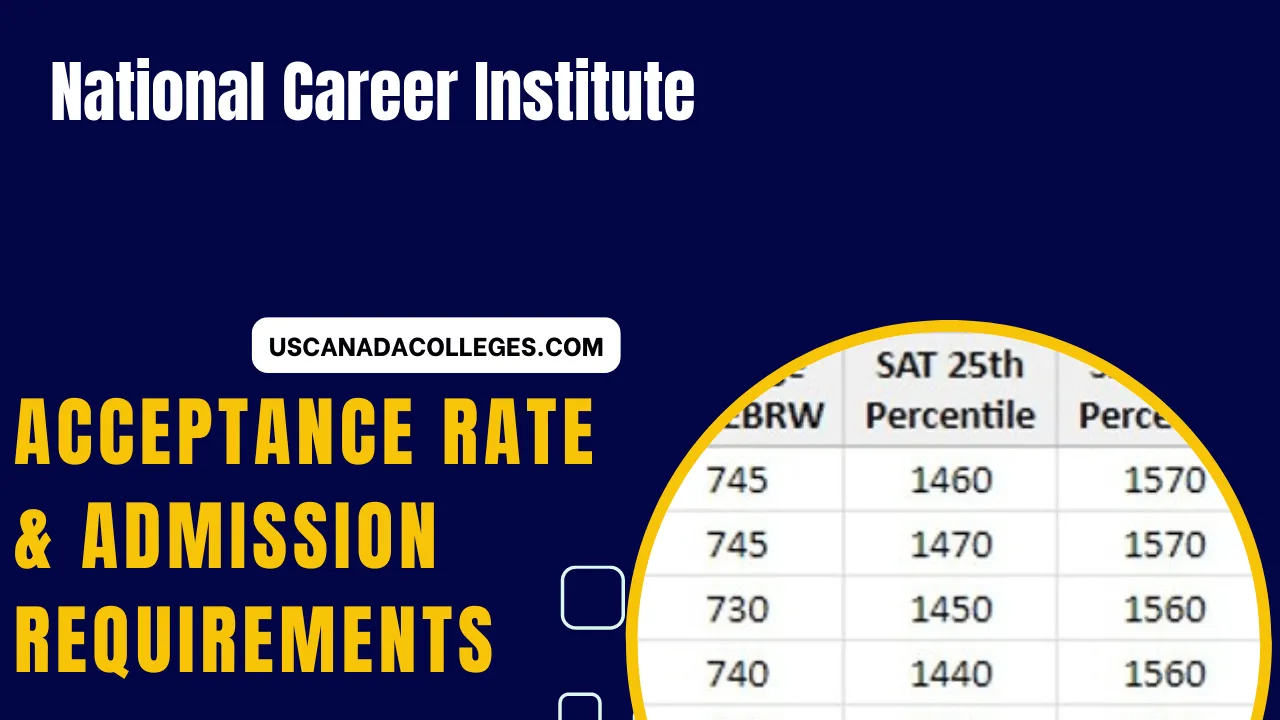
National Career Institute runs an open-access admission policy. With a 100% acceptance rate, the focus is on getting qualified students in, not filtering them out.

Slightly below-average GPA? A strong test score or clear leadership track record can still keep you competitive.
Source: IPEDS & College Scorecard (Nov 2025).
National Career Institute follows a Rolling Admissions policy, meaning applications are reviewed as they arrive and there is no single fixed deadline.
National Career Institute reviews applications continuously throughout the year. Seats and scholarships are awarded on a first-come, first-served basis, so applying early gives you a significant advantage for both admission and financial aid.
Deadlines are verified from official institutional sources but may change each cycle. Always confirm final dates on the official website.
Real-Time Sensitive Analysis — based on National Career Institute's verified institutional data
Adjust the sliders to see how every decimal point affects your outcome.
⚠️ Note: Predicting based on regional averages as this institution does not publicly report full score datasets.
Calculated via College Portal's Human-Intelligence (HI) Methodology & Editorial Standards. Verified by Sohaib Ahmad Khan.
Standardized scores still matter here: aim for the middle 50% range of the 2026 admitted class below, and if National Career Institute is test-optional, a high score submitted voluntarily still helps with merit scholarships.
National Career Institute provides an open gateway to higher education. Success here is about using available resources well and planning your longer-term academic or career path.
Look for certificate programs or internships at National Career Institute that connect directly to the local job market.
Treat this like the credential-earning step it is. A consistent course load beats sporadic part-time enrollment.
Academic advisors here can save you semesters of wasted credits if you meet with them before your first term.
A high school diploma or GED is typically the main bar. Open admission means you're in once basic requirements are met.
Whether National Career Institute is worth it depends less on its reputation and more on your program choice, financial aid package, and career goals. Here's the data to weigh it against.
61.7% of students receive a Pell Grant and 47% take federal loans at National Career Institute. File your FAFSA early and list National Career Institute as a choice to be considered for both.
Median earnings 10 years after enrollment (roughly 4–6 years post-graduation) are $26,415. That's somewhat below the U.S. median graduate income of $40,595.
Median earnings for National Career Institute graduates sit around $26,415 a year.
With 61.7% of National Career Institute students on a Pell Grant, need-based aid odds here are strong. An early FAFSA filing naming National Career Institute is the key move.
National Career Institute follows Rolling Admissions. Applications are reviewed year-round, so applying early is your best strategy.
Yes, transfers are common. Have transcripts, recommendation letters, and a solid personal statement ready to make your case.
Strong academics, a focused extracurricular profile, and standout essays move the needle most, along with a competitive SAT/ACT score where relevant.