
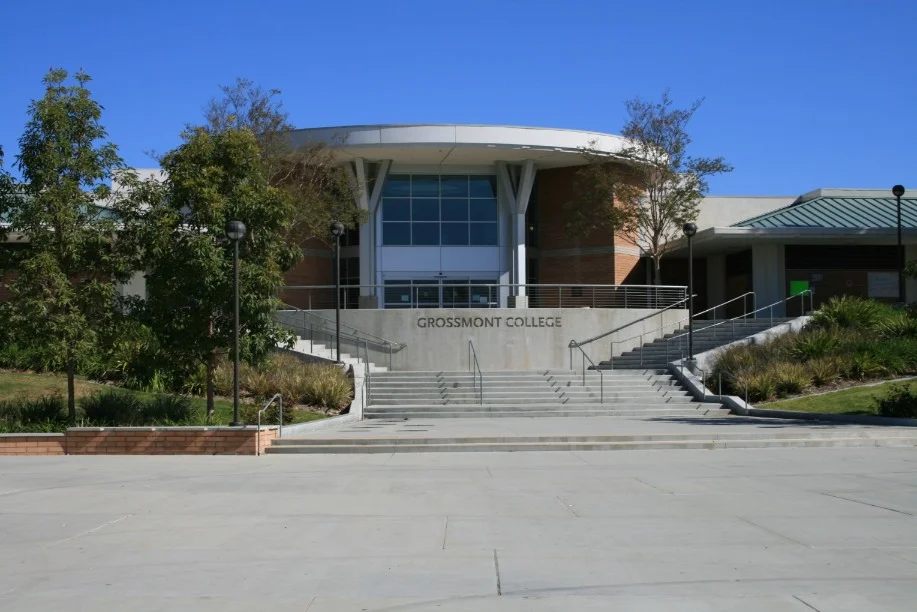
Public
Accredited · Western Association of Schools and Colleges Accrediting Commission for Community and Junior Colleges
El Cajon, California
A complete at-a-glance picture of every metric that matters for your 2026 application
Grossmont College CA Grossmont College is a highly regarded transfer institution serving students throughout the San Diego region. Many students transfer successfully to University of California and California State University campuses after completing coursework at Grossmont.\n\nThe college also offers strong career education programs in healthcare, business, public safety, and technical fields. Students benefit from comprehensive support services and a strong academic reputation.
Admission at Grossmont College is inclusive by design. 100% of applicants who meet basic eligibility are accepted.

A GPA a bit under the average isn't disqualifying at this tier. A solid test score or clear leadership record can offset it.
Source: IPEDS & College Scorecard (Nov 2025).
Grossmont College follows a Rolling Admissions policy, meaning applications are reviewed as they arrive and there is no single fixed deadline.
Grossmont College reviews applications continuously throughout the year. Seats and scholarships are awarded on a first-come, first-served basis, so applying early gives you a significant advantage for both admission and financial aid.
Deadlines are verified from official institutional sources but may change each cycle. Always confirm final dates on the official website.
Built from Grossmont College's own verified admissions data — adjust the sliders below
Adjust the sliders to see how every decimal point affects your outcome.
⚠️ Note: Predicting based on regional averages as this institution does not publicly report full score datasets.
Calculated via College Portal's Human-Intelligence (HI) Methodology & Editorial Standards. Verified by Sohaib Ahmad Khan.
Scores aren't just a formality at Grossmont College. Landing within or above the 2026 admitted class's middle 50% keeps you fully competitive, even where submission is optional.
Grossmont College provides an open gateway to higher education. Success here is about using available resources well and planning your longer-term academic or career path.
Unlike most "free college" programs, the Grossmont-Cuyamaca Promise requires no application, no forms beyond a standard FAFSA or CA Dream Act submission, and has no income requirements - it covers up to two years of tuition and mandatory fees for any eligible California resident (or AB540/tuition-exempt nonresident) enrolling full-time (12+ units) as a first-time college student. The only ongoing requirement to keep the Promise into year two is maintaining a 2.0 cumulative GPA and staying continuously enrolled full-time each fall and spring. Students who drop below 12 units in spring lose eligibility for year two - even if they maintained full-time status in fall - so schedule planning around this threshold matters from day one.
Grossmont's RN program uses a specific point-allocation grid: points are awarded for the combined weighted GPA in Anatomy, Physiology, and Microbiology (minimum 2.5 required to even apply), plus separate points for prior degrees earned in the U.S., relevant certifications, and work or volunteer healthcare experience. Critically, switching between course tracks (e.g., from separate Anatomy/Physiology courses to the combined A&P I/II sequence) counts as a course repeat and can hurt point totals - so students should pick one prerequisite track and stick with it. Applications are accepted twice yearly, every January and July, and the most recent TEAS exam version is mandatory; no prior versions are accepted.
Grossmont has a direct articulation with Point Loma Nazarene University that allows nursing students to complete their ADN at Grossmont, obtain RN licensure, and then begin PLNU's RN-to-BSN coursework on Grossmont's own campus - without transferring to a different physical location for the bachelor's-completion phase. This is a meaningful convenience for working RNs who want a four-year credential without relocating their commute or coursework schedule. Students should confirm current PLNU enrollment eligibility requirements directly, since they're set by PLNU rather than Grossmont.
Grossmont is implementing California's statewide Common Course Numbering system in phases through Fall 2027 - meaning familiar course numbers are changing (e.g., English 120 is now ENGL C1000). For currently enrolled students and those transferring in credit, this creates a real risk of confusion when checking prerequisites or building an ADT against outdated course lists. Students should always verify current course numbers directly against Grossmont's official catalog or with a counselor rather than relying on older guides, family members' past experience, or cached online information during this multi-year transition period.
The most common and costly failure pattern in Grossmont's nursing applicant pool is students who don't realize that switching prerequisite tracks counts as a repeat under the program's recency and repeat-limit rules. A student who starts with separate Anatomy and Physiology courses, struggles, and then switches to the combined A&P I/II sequence to "start fresh" discovers that the switch itself counts against their repeat limit (no more than one science prerequisite may be repeated within 5 years of application). Students should commit to one prerequisite track at the outset and seek tutoring support rather than switching tracks mid-sequence, since switching creates exactly the repeat-count problem they were trying to avoid.
Whether Grossmont College is worth it depends less on its reputation and more on your program choice, financial aid package, and career goals. Here's the data to weigh it against.
Admitted students' families report a median household income around $60,400, and graduates see a 4.13% unemployment rate.
Listed tuition runs $11,543/year at Grossmont College. Factor in Pell and federal grant aid, and most students land closer to $2,755.
At Grossmont College, 23.7% receive a Pell Grant and 1.1% carry federal loans. Filing FAFSA early and naming Grossmont College on it improves your shot at both.
Ten years out from enrollment, Grossmont College graduates report a median income of $40,309, somewhat below the U.S. median graduate income of $40,595.
Grossmont College graduates earn a lower median salary of $40,309/year, especially outside technical fields.
Tuition at Grossmont College is relatively affordable, around $11,543/year.
23.7% receive a Pell Grant here, below the ~35% national average. Grossmont College skews toward higher-income students, though merit aid may still be worth checking.
Grossmont College follows Rolling Admissions. Applications are reviewed year-round, so applying early is your best strategy.
Transferring in is a well-trodden path here. Line up your transcripts, recommendations, and a strong personal statement before applying.
The biggest levers are academic performance, a clear extracurricular focus, and essays that stand out, plus a solid test score where the school considers one.