Dartmouth College, founded in 1769, is the smallest Ivy League institution, renowned for its undergraduate focus and strong liberal arts curriculum. Located in Hanover, New Hampshire, Dartmouth offers a close-knit community with access to outdoor recreational opportunities. The college's D-Plan allows flexible scheduling, including off-campus study and internships. Dartmouth's Tuck School of Business and Thayer School of Engineering are highly regarded. The campus blends historic buildings with modern research labs and arts facilities.
Dartmouth emphasizes experiential learning, with programs like the Dartmouth Outing Club and global study trips. The college's alumni network is fiercely loyal, supporting graduates in careers ranging from finance to public service. Dartmouth's commitment to undergraduate teaching and research sets it apart. Its unique blend of tradition and innovation attracts students seeking a transformative education.
Dartmouth College Acceptance Rate
Dartmouth College is one of the leading universities in the USA. It is extremely competitive to gain admission to. The acceptance rate of Dartmouth College is 6.23%. This means that only 6 out of every 100 applicants get admitted.
Admissions Guidelines
- Elite Standards: Admitted students typically rank in the top 2-5% of their high school class.
- Curriculum Rigor: AP, IB, or Honors courses are essential to validate academic readiness.
- Character & Impact: Beyond grades, leadership, research, and unique 'spikes' in extracurriculars drive decisions.

At this level of selectivity, meeting average GPA and test scores is considered the 'baseline.' Because Dartmouth, Big Green values intellectual curiosity, your supplemental essays and personal recommendations are critical in distinguishing your application from thousands of other high-achieving candidates.
Data verified via IPEDS, College Scorecard (Nov 2025) and the Common Data Set (CDS). Expert Review led by Sohaib Khan and Dr. Waseem .
Dartmouth College Admission Requirements
Dartmouth, Big Green GPA Requirement
The average GPA of the admitted students at Dartmouth, Big Green is 3.9. This indicates extreme selectivity in admissions.
To have strong chances, you must aim for straight A’s in all courses.
Note: This is an unweighted GPA on a 4.0 scale. Students with AP or IB courses will typically have a weighted GPA of 4.10-4.30 for this same academic profile.
If your GPA is between 3.6 and 3.9, then you need a high SAT or ACT score to compensate.
Dartmouth, Big Green GPA & Admission Outlook
Assessment: Extreme selectivity; requires elite academic standing.
Recommended Strategy: High Course Rigor (AP/IB/Honors) to validate the grade.
Admissions at Dartmouth, Big Green utilize a Holistic Review process. With an average admitted GPA of 3.9, the following table illustrates how your specific academic profile aligns with institutional expectations.
| Candidate GPA Range | Admission Category | Strategic Requirement |
|---|---|---|
| 3.90 – 4.00 | Academic Target | Maintain Rigor & High Testing |
| 3.70 – 3.89 | Competitive Match | Focus on SAT/ACT Compensation |
| 3.50 – 3.69 | Secondary Reach | Personal Statement & Impact |
| Below 3.49 | Institutional Reach | Requires Significant Contextual Factors |
Expert Insight: 2026 Evaluation Metrics
- The Rigor Metric: At Dartmouth, Big Green, a slightly lower GPA (e.g., 3.8) in a transcript featuring multiple AP or IB courses is often prioritized over a 4.0 in a standard curriculum.
- The Upward Trend: If your early high school grades were lower, an upward trajectory in 11th and 12th grade demonstrates Academic Resilience.
Data Source: Verified via IPEDS and latest Common Data Set (CDS). Reviewed by our academic board led by Sohaib Khan and Dr. Waseem.
Admission Chance Predictor
Real-Time Sensitive Analysis
Adjust the sliders to see how every decimal point affects your outcome.
Calculated via College Portal’s Human-Intelligence (HI) Methodology & Editorial Standards.
Verified by Sohaib Ahmad Khan.
Dartmouth College (Dartmouth, Big Green) Test Requirements
In this competitive environment, standardized scores are no longer elective; they serve as a critical standardized benchmark to validate high school GPA and course rigor. Applicants should aim for scores within or above the middle 50% range of the 2025 admitted class to remain viable in the Holistic Review process. At institutions that remain test-optional, submitting a high-percentile score is still the primary strategy for securing merit-based scholarships and distinguishing one's profile in a high-volume applicant pool.
Dartmouth College Average SAT Score: 1533
The average SAT score of the admitted students at Dartmouth College is 1533 on the 1600 SAT scale.
SAT Competitiveness
This score makes it Extremely Competitive for SAT test scores. You need to do extremely well to score 1533 on the SAT.
Key Insight:Aim for the 75th percentile (1570 SAT or 35 ACT) to stand out. If your scores are below average, consider retaking the test. Dartmouth College allows Score Choice for the SAT and Superscoring for the ACT, giving you flexibility to submit your best scores.
If your score is below 1500, retaking the SAT is strongly recommended to improve your chances at Dartmouth, Big Green.Retaking the test multiple times is completely normal, most competitive applicants take the SAT two or three times to achieve their best score. There is no official limit on attempts.
SAT Scores Breakdown by Sections
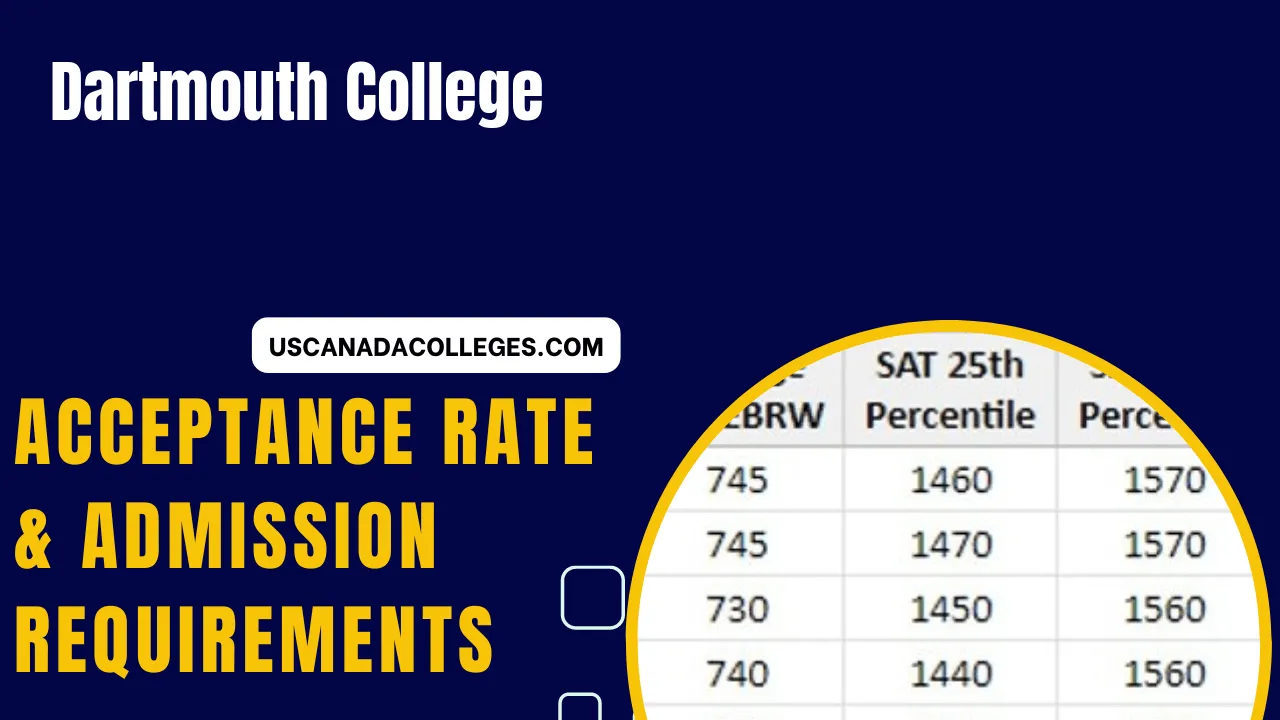
| Section | Average | 25th Percentile | 75th Percentile |
|---|---|---|---|
| SAT Math | 775 | 760 | 790 |
| SAT Reading | 760 | 740 | 780 |
| SAT Composite | 1533 | 1500 | 1570 |
It means that if you have scored less than 1500 then you are below most of the admitted students at Dartmouth, Big Green and your chances of admission are very few. But if you have scored 1570 or more, your chances of admission are higher. 25th percentile means that only 25% of the admitted students have fewer scores than this score. 75th percentile marks the score of the upper 25% of the students. View list of all colleges with average SAT score of 1550
Can I get into Dartmouth College (Dartmouth, Big Green) with a 1550 SAT?
With a 1550 SAT Score, your chances of admission at Dartmouth College (Dartmouth, Big Green) are good but the admission staff at Dartmouth, Big Green tests your all-around personality and your academics. Your GPA, Class performance, SAT/ACT/Test scores, and AP or IB Courses can help your application stand out. Co-curricular and extra-curricular activities and interpersonal communication skills are very important. Additionally, if you cannot perform well in one area, you have a chance to showcase your strengths and abilities in other areas, improving other areas will help you secure admission. You need to show better performance in all areas. An equally high GPA, taking IB or AP Courses and your role in leadership activities will increase your chances of admission. However, if you equally compete well in all other areas, your chances of admission are high.
Dartmouth College (Dartmouth, Big Green) ACT Requirements
The average ACT Score at Dartmouth, Big Green is 34.
ACT Competitiveness
This score makes Dartmouth College Extremely Competitive for ACT scores. You need to do extremely well to score 34 on the ACT.
ACT Scores Breakdown by Sections
| Section | Average | 25th Percentile | 75th Percentile |
|---|---|---|---|
| ACT Math | 33 | 31 | 35 |
| ACT English | 36 | 35 | 36 |
| ACT Composite | 34 | 33 | 35 |
Can I get into Dartmouth College with a 35 ACT?
A 35 ACT places you at the 75th percentile of admitted students at Dartmouth College — meaning you score higher than 75% of students who were accepted. This is a strong position, but the ACT is just one dimension of your application. Admissions officers at Dartmouth College use the ACT as a benchmark to validate your academic readiness, not as a standalone admission ticket.
Unlike the SAT, the ACT measures four distinct subject areas — English, Mathematics, Reading, and Science — each scored on a 1–36 scale. If one of your section scores is significantly lower than the others, admissions staff will notice the imbalance. For example, a weak ACT Science score at a STEM-focused institution carries more weight than the same weakness at a liberal arts college. It is worth reviewing your section-level scores and addressing any outliers before applying.
One important advantage the ACT has over the SAT is that Dartmouth College — like most US universities — accepts Superscoring for the ACT, meaning they take your highest section scores across multiple test attempts and combine them into a new composite. If you have taken the ACT more than once, confirm whether Dartmouth College uses Superscoring, as this could meaningfully improve your effective composite beyond what any single sitting shows.
Beyond your score, what ultimately determines admission at this level is the strength of your overall profile. Your unweighted GPA, course rigor (AP, IB, or dual enrollment), extracurricular depth, letters of recommendation, and personal essays all carry significant weight. A 35 ACT gets your application through the first filter — but your essays and activities are what move it forward from there.
View a list of all colleges with an average ACT score of 34.Dartmouth, Big Green Profile
Name: Dartmouth College (Dartmouth, Big Green)
City: Hanover
State: New Hampshire
Type: Non-Profit Private
Zip: 03755-3529
Campus: Main
Accredited by: New England Commission on Higher Education (NECHE)
Elite Strategy: The 'Spike' Approach
To be successful at a world-class institution like Dartmouth, Big Green, you must move beyond being 'well-rounded' and demonstrate that you are institutionally necessary.
Elite schools favor 'pointy' students; those who are world-class in one niche. Achieve national-level recognition or produce original research rather than joining ten generic clubs.
Demonstrate 'self-driven learning.' This includes graduate-level coursework, mastering a complex skill independently, or attending top-tier summer programs (RSI/TASP).
Avoid safe, cliché topics. Use the supplemental essays to showcase creative risk-taking, quirky intellectualism, and authentic personality.
Admissions officers prioritize 'Founders' and 'Change-makers' over 'Office-holders.' Document quantifiable impact—what did you build that didn't exist before?
Can I Get Into Dartmouth, Big Green Without SAT Or ACT?: Dartmouth College considers admission test scores (SAT/ACT) during the application process but does not require them. Although it is not strictly a requirement, the test scores are considered for admission decisions. Hence, it is advisable to prepare well for the test and submit the best scores. Normally, students may appear in the test 2 to 3 times to improve their scores. Hence you are required to plan early and appear in upcoming SAT / ACT tests. Check the schedule of the test and plan accordingly. It is advisable to appear multiple times in the test unless you score well above the average SAT / ACT score of the admitted students, as given below.
Is a Dartmouth, Big Green degree Worth It?
Getting into Dartmouth, Big Green can be a great opportunity for many students. It is a prestigious institution known for its strong programs. However, whether it is worth it depends on your personal and academic goals, as well as your financial situation. Dartmouth, Big Green offers a rigorous academic environment and access to cutting-edge research, but it may not be the best fit for everyone. It's important to consider factors such as cost, location, and specific academic programs when making this decision. Please note that the average household income of the admitted students at Dartmouth, Big Green is $79,800 and unemployment rate is 3.18%.
How much does a degree from Dartmouth, Big Green Cost?The average annual cost of the degree at Dartmouth College is $83,802. As most of the students receive Pell Grants and Federal Grants the average annual net price a student has to pay at Dartmouth College is much less than this.
14.83% of the students are receiving Pell Grant and 11.98 percent are receiving Federal Grants. So it is a better choice to go to Dartmouth, Big Green and apply for PELL or federal loan grants.
At Dartmouth College, you will have no problem receiving any scholarship from the federal government. Fill in the FAFSA application form at the earliest and enlist Dartmouth, Big Green as your choice in the form.
How much does a Dartmouth, Big Green Graduate earn?
The average annual salary of the graduate after 4-6 years of graduation is $97,434. An average Dartmouth, Big Green graduate makes this much after 10 years of enrollment (4-6 years after graduation).
The average annual income of a graduate in the United States is $40,595

Less Competitive Schools
These schools have lower average SAT or ACT scores than Dartmouth College. If your SAT or ACT score is slightly lower, you'll be competitive for these schools.
| School | Location | SAT | ACT |
|---|---|---|---|
| Claremont McKenna College | Claremont McKenna College, CA | 1514 | 34 |
| Pomona College | Pomona College, CA | 1520 | 34 |
| University of Southern California | University of Southern California, CA | 1501 | 34 |
| Wesleyan University | Wesleyan University, CT | 1513 | 34 |
| Georgetown University | Georgetown University, DC | 1494 | 33 |
| Emory University | Emory University, GA | 1507 | 33 |
| University of Notre Dame | University of Notre Dame, IN | 1510 | 34 |
| Grinnell College | Grinnell College, IA | 1486 | 33 |
| Bowdoin College | Bowdoin College, ME | 1514 | 34 |
| Colby College | Colby College, ME | 1500 | 33 |

Equally Competitive Schools
These schools have the same range of average SAT or ACT scores as Dartmouth College. If your SAT or ACT score are competitive, you'll be competitive for these schools also.
| School | Location | SAT | ACT |
|---|---|---|---|
| Harvey Mudd College | Harvey Mudd College, CA | 1537 | 35 |
| Yale University | Yale University, CT | 1534 | 34 |
| Northwestern University | Northwestern University, IL | 1526 | 34 |
| Williams College | Williams College, MA | 1527 | 34 |
| Washington University in St Louis | Washington University in St Louis, MO | 1530 | 34 |

More Competitive Schools
These schools have higher average SAT or ACT scores than Dartmouth College. If you improve your SAT or ACT score, you'll be competitive for these schools.
| School | Location | SAT | ACT |
|---|
Degree Programs
Bachelor Degree Programs
- Anthropology
- Area Studies
- Astronomy and Astrophysics
- Biochemistry, Biophysics and Molecular Biology
- Biology, General
- Biomedical/Medical Engineering
- Cell/Cellular Biology and Anatomical Sciences
- Chemistry
- Classical and Ancient Studies
- Classics and Classical Languages, Literatures, and Linguistics
Frequently Asked Questions About Dartmouth College Admissions
Answer: Graduates of this university typically earn a high salary, $97,434 annually, depending on the industry.
Question: What is the tuition fee?
Answer: The tuition fee at this university is quite high, approximately $83,802 or more per year, so it is important to consider additional funding options.
Question: What are my chances of getting a scholarship ?
Answer: 14.8% of students receive a Pell Grant here, which is below the national average of around 35%. This institution serves a higher proportion of higher-income students. Merit-based scholarships may still be available regardless of financial need — check the institution's official financial aid page for details.
Question: What is the acceptance rate?
Answer: The acceptance rate of Dartmouth College is 6.23% which is extremely low. Admission is highly competitive, and only the top candidates are accepted.
Question: What is the average GPA of admitted students?
Answer: The average GPA of admitted students is 3.9. This reflects the competitive academic profile expected from applicants.
Question: What is the minimum GPA required for admission?
Answer: While there is no single 'cutoff' that guarantees a rejection, admission staff uses your GPA to determine if you are a best fit. If you have at least a 3.6, you're in the standard pool. If you are below a 3.6, we need to focus on your personal essay and letters of recommendation to explain the context behind your grades.
Question: What are my chances with a 3.6 GPA?
Answer: If your GPA is 3.5 or less, it may makes admission difficult. However, your chances may improve if you have strong test scores, extracurricular activities, and essays. But this does not mean that you must not apply, or you do not have any chances. With additional AP courses, you can increase your chances even with this GPA.
Question: Can I apply to Dartmouth College if my GPA is below 3.6
Answer: While the average GPA of admitted students is 3.9, applicants with lower GPAs can still be considered if they have strong test scores, extracurriculars, and compelling personal essays that demonstrate resilience and potential.
Question: How competitive is the SAT score requirement
Answer: Admission to Dartmouth College is based on SAT, and a strong SAT score is essential. Aim for scores above 1533 for the best chances, although the overall application strength also matters. Your SAT must be in the range of 1500-1570
Question: Is it possible to transfer from another university?
Answer: Yes, many students successfully transfer each year. Be prepared with your academic transcripts, recommendation letters, and a solid personal statement to make your application competitive.
Question: How can I improve my chances of getting Admissions?
Answer: To improve your chances, focus on excelling academically, building a strong extracurricular profile, and submitting standout essays. High SAT/ACT scores are also crucial for competitive admissions.
Full list of All degree programs offered by Dartmouth College.
Last Updated: Wednesday March 18, 2026
Data on this page is sourced from IPEDS, College Scorecard's latest data as provided in November 2025, US Department of Education's latest statistics, Institute's official websites and printed material as well as additional publicly available sources.