
Non-Profit Private
Accredited · Transnational Association of Christian Colleges and Schools
Dallas, Texas
33.8% Acceptance Rate
A complete at-a-glance picture of every metric that matters for your 2026 application
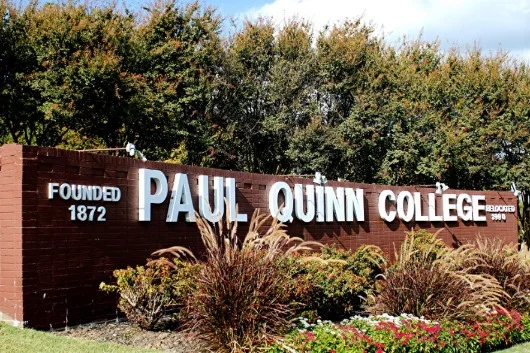
Paul Quinn College, an HBCU established in 1872 in Dallas, Texas, is known for its urban work college model, requiring students to work while studying. It ranks for social mobility and innovative programs like 'Farm-to-Table' agriculture.
The campus features urban gardens, a business incubator, and renovated dormitories. Its focus on leadership and service prepares graduates for community impact.
Paul Quinn College admits roughly 33.8% of its applicant pool, keeping it competitive without being out of reach for a solid student.

Slightly below-average GPA? A strong test score or clear leadership track record can still keep you competitive.
Source: IPEDS & College Scorecard (Nov 2025).
The application deadline for Paul Quinn College is December 1 for Priority applicants, with additional plans listed below.
💡 The scholarship deadline (December 1, 2026) often falls before the regular admission deadline. Submit your application and FAFSA early to be considered for maximum aid.
Deadlines are verified from official institutional sources but may change each cycle. Always confirm final dates on the official website.
The average GPA of admitted students at Paul Quinn College is 2.6. That makes admissions here less selective on GPA specifically. Most admitted students carry a mix of B's and C's.
A solid SAT or ACT score is the fastest way to strengthen an application in this range.
Most schools report GPA on a weighted or unweighted 4.0 scale differently. For an unweighted profile like this, students with AP/IB coursework typically carry a weighted GPA of 2.80–3.00.Real-Time Sensitive Analysis — based on Paul Quinn College's verified institutional data
Adjust the sliders to see how every decimal point affects your outcome.
✅ Verified Data: Institutional records for 2026.
Calculated via College Portal's Human-Intelligence (HI) Methodology & Editorial Standards. Verified by Sohaib Ahmad Khan.
Standardized scores still matter here: aim for the middle 50% range of the 2026 admitted class below, and if Paul Quinn College is test-optional, a high score submitted voluntarily still helps with merit scholarships.
The average SAT score of admitted students at Paul Quinn College is 935 on the 1600-point scale.

This average is on the lower end nationally, making a strong score here a genuine advantage.
If your score is below 895, retaking the SAT is strongly recommended to improve your chances at Paul Quinn College. Retaking multiple times is completely normal. Most competitive applicants sit for it two or three times. There's no official limit on attempts.
| Section | Average | 25th Percentile | 75th Percentile |
|---|---|---|---|
| SAT Math | - | - | - |
| SAT Reading | - | - | - |
| SAT Composite | 935 | 895 | 965 |
Below 895, you're behind most admitted students; at 965 or above, you're ahead of 75% of them. (25th/75th percentile = the score below which that share of admitted students fall.)
View list of all colleges with average SAT score of 950
A 950 SAT puts you ahead of most of Paul Quinn College's admitted class, but admissions still weighs GPA, course rigor, and essays alongside it. A strong score opens the door; the rest of your profile decides what happens next.
Competitive positioning at Paul Quinn College means clearing the academic bar comfortably, then using the rest of your application to show genuine fit.
Paul Quinn College is America's only federally designated Urban Work College - a category created specifically for it when it achieved that designation in 2017. Every residential student participates in the Work Program, interning approximately 15 hours per week with corporate partners including JP Morgan Chase, Oncor, Capital One, and others in the Dallas-Fort Worth metro. These are not campus jobs or volunteer placements - they are structured, paid pre-professional internships that reduce tuition costs and build a verifiable resume before graduation. The Work Program is not optional for residential students; it is a defining feature of the degree. Students who thrive at Paul Quinn are those who actively want work experience integrated into their education, not students seeking a traditional campus experience. The application's recommendation letter specifically asks for evidence of coachability, reliability, and work ethic - not just academic achievement.
Paul Quinn uses its own 'WE Over Me' application (not Common App), which requires a high school transcript, a resume documenting activities including athletics, community service, family responsibilities, employment, or internships, and a recommendation letter from a non-relative that speaks specifically to coachability, reliability, and work ethic. Test scores are not required or considered for admission - PQC is fully test-blind. GPA is the primary academic signal, with the average admitted student at approximately 2.60 unweighted. The recommendation letter is a meaningful differentiator: a specific, credible account of a student demonstrating reliability, leadership, or community engagement in a real context carries more weight in this review process than a generic academic reference. Students whose record shows consistent engagement - jobs, caregiving, service - have a natural advantage here.
Upon admission, students receive a Commitment Form that simultaneously registers them for Summer Bridge - a 10-day pre-semester orientation program that is the entry point into the Paul Quinn community and Work Program. The 2026 Summer Bridge runs June 14-24. Summer Bridge is not a casual welcome week; it is a structured academic and professional orientation that introduces students to the WE Over Me ethos, the internship pipeline, and the habits and accountability structures that Paul Quinn explicitly teaches. Families should budget for Summer Bridge separately from the fall semester - for 2025-26, students with full Pell Grant eligibility paid approximately $763 out-of-pocket for Summer Bridge including housing, meals, and tuition; students without full Pell Grant access faced up to approximately $3,536. Confirm current-year costs with the enrollment office before making plans.
Paul Quinn converted its football field into the WE Over Me Farm in 2010, producing more than 30,000 pounds of organically grown produce since then, supplying Dallas-area restaurants, the campus cafeteria, and local community organizations. Student employees manage farm operations, business planning, and marketing as part of the Work Program. In 2021, Legends Hospitality at AT&T Stadium added a partnership with the Farm for vegetarian concessions on Dallas Cowboys game days - a concrete example of a college-connected enterprise reaching a national platform. For students interested in food justice, urban agriculture, social entrepreneurship, or business operations in a mission-driven context, the Farm is a distinctive academic and professional resource. The Dallas location also places students in one of the most economically dynamic metros in the US for finance, energy, technology, and corporate internship access beyond the Work Program partners.
Paul Quinn's six-year graduation rate is approximately 27% (Niche), and the overall completion picture for students who enroll reflects real attrition - a function of serving a student population with significant financial need, many of whom are first-generation, and a campus that is still rebuilding infrastructure (16 buildings were demolished under the current president's tenure as part of a renewal plan). The Work Program, Summer Bridge, and the WE Over Me ethos are genuinely distinctive and have earned national recognition, but students should enter with clear professional goals, strong support networks, and a realistic understanding that Paul Quinn's model rewards students who actively engage with it. Students who enroll expecting a conventional residential college experience - traditional social life, extensive extracurricular programming, comprehensive campus amenities - may find the reality challenging.
Whether Paul Quinn College is worth it depends less on its reputation and more on your program choice, financial aid package, and career goals. Here's the data to weigh it against.
The average household income among admitted students is $52,600, with a graduate unemployment rate of 4.92%.
The sticker price is $24,912/year, but the average net price students actually pay, after Pell and federal grants, is typically much lower.
69.8% of students receive a Pell Grant and 55.7% take federal loans at Paul Quinn College. File your FAFSA early and list Paul Quinn College as a choice to be considered for both.
Median earnings 10 years after enrollment (roughly 4–6 years post-graduation) are $29,288. That's somewhat below the U.S. median graduate income of $40,595.

These schools have lower average SAT or ACT scores than Paul Quinn College. If your SAT or ACT score is slightly lower, you'll be competitive for these schools.
| School | Location | SAT | ACT |
|---|---|---|---|
| University of Arkansas at Pine Bluff | Pine Bluff, AR | 916 | 16 |
| Bethune-Cookman University | Daytona Beach, FL | 913 | 17 |
| Trinity College of Florida | Trinity, FL | 905 | 19 |
| Wesleyan College | Macon, GA | 905 | NA |
| Morningside University | Sioux City, IA | 910 | 17 |
| Kentucky State University | Frankfort, KY | 910 | 17 |
| Southern University at New Orleans | New Orleans, LA | 910 | 16 |
| Maine College of Health Professions | Lewiston, ME | 910 | NA |
| Washington Adventist University | Takoma Park, MD | 920 | NA |
| Mississippi Valley State University | Itta Bena, MS | 910 | 16 |

These schools have the same range of average SAT or ACT scores as Paul Quinn College. If your SAT or ACT score is competitive, you'll be competitive for these schools also.
| School | Location | SAT | ACT |
|---|---|---|---|
| Johnson University Florida | Kissimmee, FL | 940 | NA |
| Warner University | Lake Wales, FL | 937 | 17 |
| Upper Iowa University | Fayette, IA | 929 | 18 |
| Southern University and A & M College | Baton Rouge, LA | 938 | 17 |
| Bowie State University | Bowie, MD | 935 | NA |

These schools have higher average SAT or ACT scores than Paul Quinn College. If you improve your SAT or ACT score, you'll be competitive for these schools.
| School | Location | SAT | ACT |
|---|---|---|---|
| Alabama State University | Montgomery, AL | 977 | 18 |
| University of West Alabama | Livingston, AL | 1015 | 20 |
| Baptist Health College Little Rock | Little Rock, AR | 980 | 20 |
| Metropolitan State University of Denver | Denver, CO | 1014 | 20 |
| Colorado State University Pueblo | Pueblo, CO | 1005 | 22 |
Median earnings for Paul Quinn College graduates sit around $29,288 a year.
At about $24,912 a year, Paul Quinn College is on the more affordable end.
With 69.8% of Paul Quinn College students on a Pell Grant, need-based aid odds here are strong. An early FAFSA filing naming Paul Quinn College is the key move.
At 33.8%, Paul Quinn College's acceptance rate is on the more attainable end compared to top-tier selective schools.
Admitted students at Paul Quinn College average a 2.6 GPA.
Paul Quinn College doesn't publish a hard GPA floor, but landing at or above 2.3 keeps you in the typical applicant range; below it, lean on essays and recommendations.
Below 2.2, Paul Quinn College becomes a harder reach, though a strong test score, meaningful activities, and AP/IB coursework can still make a real case.
A strong SAT score matters at Paul Quinn College — aim above 935, ideally within the 895–965 range admitted students typically fall in.
The application deadline for Paul Quinn College is December 1 for Priority applicants.
The scholarship/financial aid priority deadline is December 1, 2026. Submit FAFSA before then for maximum consideration.
Yes, transfers are common. Have transcripts, recommendation letters, and a solid personal statement ready to make your case.
Strong academics, a focused extracurricular profile, and standout essays move the needle most, along with a competitive SAT/ACT score where relevant.