Public
Accredited · Higher Learning Commission
Dearborn, Michigan
58.6% Acceptance Rate
A complete at-a-glance picture of every metric that matters for your 2026 application
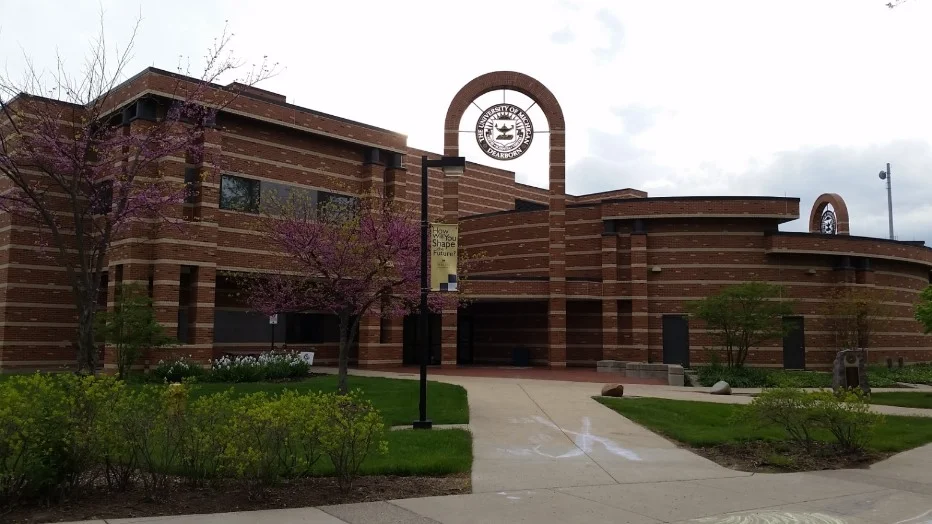
The University of Michigan-Dearborn, established in 1959, is a public university known for its strong engineering, business, and computer science programs. Located in Dearborn, Michigan, it ranks among the top regional universities in the Midwest, offering a blend of research opportunities and industry connections.
The campus features modern facilities, including engineering labs, a business innovation center, and collaborative study spaces. Its proximity to Detroit provides students with internship and career opportunities, while its diverse student body enriches the learning experience.
University of Michigan-Dearborn is moderately selective. 58.6% of applicants are admitted, with room for a well-rounded, if imperfect, transcript.

Source: IPEDS & College Scorecard (Nov 2025).
University of Michigan-Dearborn follows a Rolling Admissions policy, meaning applications are reviewed as they arrive and there is no single fixed deadline, though the priority deadline of February 1 is recommended for the best chances of admission and financial aid.
UM-Dearborn reviews applications continuously throughout the year. Seats and scholarships are awarded on a first-come, first-served basis, so applying early gives you a significant advantage for both admission and financial aid.
💡 The scholarship deadline (February 1, 2026) often falls before the regular admission deadline. Submit your application and FAFSA early to be considered for maximum aid.
Deadlines are verified from official institutional sources but may change each cycle. Always confirm final dates on the official website.
The average GPA of admitted students at UM-Dearborn is 3.66. That makes admissions here highly selective. Most admitted students carry mostly A's with the occasional B.
Between 3.36 and 3.66? A strong standardized test score is worth prioritizing.
Most schools report GPA on a weighted or unweighted 4.0 scale differently. For an unweighted profile like this, students with AP/IB coursework typically carry a weighted GPA of 3.86–4.06.Assessment: Selective; solid academic performance is expected.
Recommended Strategy: Focus on a Strong 'Spike' in extracurriculars or research.
Where your GPA falls in this range shapes what the rest of your application needs to do:
Data verified via IPEDS, College Scorecard (Nov 2025) and the Common Data Set (CDS). Expert Review led by Sohaib Khan and Dr. Waseem.
Real-Time Sensitive Analysis — based on University of Michigan-Dearborn's verified institutional data
Adjust the sliders to see how every decimal point affects your outcome.
✅ Verified Data: Institutional records for 2026.
Calculated via College Portal's Human-Intelligence (HI) Methodology & Editorial Standards. Verified by Sohaib Ahmad Khan.
Standardized scores still matter here: aim for the middle 50% range of the 2026 admitted class below, and if UM-Dearborn is test-optional, a high score submitted voluntarily still helps with merit scholarships.
The average SAT score of admitted students at University of Michigan-Dearborn is 1127 on the 1600-point scale.

This average is slightly below the national mean SAT score.
If your score is below 990, retaking the SAT is strongly recommended to improve your chances at UM-Dearborn. Retaking multiple times is completely normal. Most competitive applicants sit for it two or three times. There's no official limit on attempts.
| Section | Average | 25th Percentile | 75th Percentile |
|---|---|---|---|
| SAT Math | 560 | 490 | 630 |
| SAT Reading | 565 | 500 | 630 |
| SAT Composite | 1127 | 990 | 1260 |
Below 990, you're behind most admitted students; at 1260 or above, you're ahead of 75% of them. (25th/75th percentile = the score below which that share of admitted students fall.)
View list of all colleges with average SAT score of 1150
A 1250 SAT puts you ahead of most of UM-Dearborn's admitted class, but admissions still weighs GPA, course rigor, and essays alongside it. A strong score opens the door; the rest of your profile decides what happens next.
The average ACT score at UM-Dearborn is 27.

This average is solidly above the national mean without being elite-tier.
| Section | Average | 25th Percentile | 75th Percentile |
|---|---|---|---|
| ACT Math | 26 | 23 | 29 |
| ACT English | 27 | 23 | 30 |
| ACT Composite | 27 | 23 | 30 |
A 30 ACT puts you ahead of 75% of UM-Dearborn's admitted students. That's a strong position, though the ACT is only one benchmark among several that admissions weighs.
Unlike the SAT, the ACT scores four separate sections: English, Math, Reading, and Science, each on a 1–36 scale. A noticeably weak section, especially Science at STEM-focused schools, stands out to reviewers, so it's worth checking your section breakdown for outliers before applying.
Your ACT score clears the first filter, but GPA, course rigor, extracurricular depth, recommendations, and essays are what carry an application the rest of the way at UM-Dearborn.
UM-Dearborn takes a broad view of applicants. Your energy is best spent proving readiness for coursework and maximizing your financial aid package.
UM-Dearborn charges no application fee for first-year students, requires no personal essay, and requires no letters of recommendation. This is not a reflection of lower selectivity - it reflects the university's explicit mission as an access-focused institution (named a top-tier "Opportunity University" by Carnegie and the American Council on Education in 2025). The application requires a high school transcript, self-reported test scores (optional), and basic information. Applying by December 1 is encouraged for full scholarship consideration; the standard deadline is April 1. Michigan residents with a 3.0+ GPA are guaranteed admission under the Michigan Assured Admissions Pact, a statewide policy that makes admissibility predictable. The absence of supplemental materials means transcript quality and course rigor are the primary factors in every admission decision.
While UM-Dearborn's application window runs through April 1, the most competitive scholarship consideration for fall enrollment is awarded on a rolling basis beginning with December 1 applicants. UM-Dearborn holds the distinction of having the lowest annual average cost among all 15 public universities in Michigan (per the U.S. Department of Education College Scorecard), and 82% of first-year students receive need-based financial aid - with an average net price for federal loan recipients of $12,102. A student who applies in March may still be admitted but will be competing for a depleted merit pool. The correct sequence is apply by December 1, complete the FAFSA immediately, and request any merit scholarship review as part of the initial file review rather than as a later amendment.
UM-Dearborn was founded in 1959 on 202 acres of the former estate of Henry Ford, established with a direct gift of land and $6.5 million from the Ford Motor Company to address an acute shortage of college-educated engineers and business administrators in the Detroit auto industry. The campus still sits adjacent to Fair Lane, Henry Ford's historic mansion, and borders Henry Ford College across Evergreen Road. The Ford Motor Company connection is not historical background - it is a living industry relationship. 94% of UM-Dearborn students are Michigan residents, over 95% of employed graduates work in Michigan, and the university's curriculum has been explicitly reoriented around practice-based learning in collaboration with Metro Detroit industry partners. Engineering, business, and computer science applicants who can articulate a connection between their goals and the Metro Detroit industry ecosystem - automotive, mobility, electrification, defense, logistics - are making the most relevant possible argument for choosing UM-Dearborn over other Michigan public universities.
UM-Dearborn and Henry Ford College (HFC), whose campuses share Evergreen Road, operate a dedicated transfer partnership called Learn4ward that provides guaranteed admission to UM-Dearborn upon completion of program requirements at HFC, plus articulation agreements for specific academic programs ensuring detailed, credit-matched graduation pathways. Students who start at HFC with the intention of transferring to UM-Dearborn should identify the Learn4ward pathway explicitly at the time of HFC enrollment - the program provides a structured plan to earn both an associate degree and a bachelor's degree within 4?6 years with full credit portability. For Michigan students who face financial constraints in year one, Learn4ward is one of the most functionally useful transfer pathways in the state and should be counseled proactively, not discovered retroactively.
UM-Dearborn's four-year graduation rate is approximately 33% - notably lower than its six-year rate of 60% - because it enrolls a predominantly non-traditional, commuter student population: 44% of students are first-generation college students, many students work full-time while enrolled, and the institution explicitly serves returning adults, veterans, and parents through its SOAR Program. A student or family comparing UM-Dearborn's four-year graduation rate to a residential university without understanding this demographic context is making a structurally flawed comparison. The 60% six-year graduation rate is the more relevant data point, and it reflects sustained institutional investment in student success support - not a weak academic environment. Counselors who use the four-year rate without this context are misrepresenting the institution to families for whom UM-Dearborn would otherwise be an excellent fit.
UM-Dearborn offers a rigorous academic environment, but 'worth it' is a personal calculation of cost, program fit, and outcomes. The figures below are a starting point.
The average household income among admitted students is $67,600, with a graduate unemployment rate of 3.49%.
The sticker price is $22,435/year, but the average net price students actually pay, after Pell and federal grants, is closer to $10,904.
43.9% of students receive a Pell Grant and 38.4% take federal loans at UM-Dearborn. File your FAFSA early and list UM-Dearborn as a choice to be considered for both.
Median earnings 10 years after enrollment (roughly 4–6 years post-graduation) are $59,649. That's about 47% above the U.S. median graduate income.

These schools have lower average SAT or ACT scores than University of Michigan-Dearborn. If your SAT or ACT score is slightly lower, you'll be competitive for these schools.
| School | Location | SAT | ACT |
|---|---|---|---|
| Auburn University at Montgomery | Montgomery, AL | 1090 | 21 |
| Spring Hill College | Mobile, AL | 1090 | 22 |
| Troy University | Troy, AL | 1086 | 22 |
| Grand Canyon University | Phoenix, AZ | 1095 | 22 |
| University of Central Arkansas | Conway, AR | 1117 | 22 |
| University of the Ozarks | Clarksville, AR | 1088 | 21 |
| University of La Verne | La Verne, CA | 1116 | 22 |
| Pacific Union College | Angwin, CA | 1093 | 22 |
| Fort Lewis College | Durango, CO | 1084 | 20 |
| University of Northern Colorado | Greeley, CO | 1077 | 22 |

These schools have the same range of average SAT or ACT scores as University of Michigan-Dearborn. If your SAT or ACT score is competitive, you'll be competitive for these schools also.
| School | Location | SAT | ACT |
|---|---|---|---|
| University of South Alabama | Mobile, AL | 1119 | 23 |
| Tuskegee University | Tuskegee, AL | 1121 | 22 |
| Arkansas State University | Jonesboro, AR | 1119 | 22 |
| University of Central Arkansas | Conway, AR | 1117 | 22 |
| University of Colorado Denver/Anschutz Medical Campus | Denver, CO | 1119 | 24 |

These schools have higher average SAT or ACT scores than University of Michigan-Dearborn. If you improve your SAT or ACT score, you'll be competitive for these schools.
| School | Location | SAT | ACT |
|---|---|---|---|
| Birmingham-Southern College | Birmingham, AL | 1197 | 24 |
| Samford University | Birmingham, AL | 1203 | 26 |
| University of Arkansas | Fayetteville, AR | 1174 | 25 |
| Harding University | Searcy, AR | 1187 | 25 |
| Dominican University of California | San Rafael, CA | 1194 | 26 |
Median graduate earnings at University of Michigan-Dearborn run about $59,649 a year.
At about $22,435 a year, University of Michigan-Dearborn is on the more affordable end.
About 43.9% receive a Pell Grant at University of Michigan-Dearborn. The odds are moderate and largely income-dependent, but an early FAFSA filing still helps.
At 58.6%, University of Michigan-Dearborn's acceptance rate is on the more attainable end compared to top-tier selective schools.
Admitted students at University of Michigan-Dearborn average a 3.66 GPA.
University of Michigan-Dearborn doesn't publish a hard GPA floor, but landing at or above 3.36 keeps you in the typical applicant range; below it, lean on essays and recommendations.
Below 3.26, University of Michigan-Dearborn becomes a harder reach, though a strong test score, meaningful activities, and AP/IB coursework can still make a real case.
A strong SAT score matters at University of Michigan-Dearborn — aim above 1127, ideally within the 990–1260 range admitted students typically fall in.
The application deadline for University of Michigan-Dearborn is February 1. Rolling Admissions is also offered, so applying early improves your chances.
The application fee is 60. Fee waivers may be available. Check with admissions.
The scholarship/financial aid priority deadline is February 1, 2026. Submit FAFSA before then for maximum consideration.
Yes, transfers are common. Have transcripts, recommendation letters, and a solid personal statement ready to make your case.
Strong academics, a focused extracurricular profile, and standout essays move the needle most, along with a competitive SAT/ACT score where relevant.