Non-Profit Private
Accredited · Middle States Commission on Higher Education
Princeton, New Jersey
4.5% Acceptance Rate
A complete at-a-glance picture of every metric that matters for your 2026 application
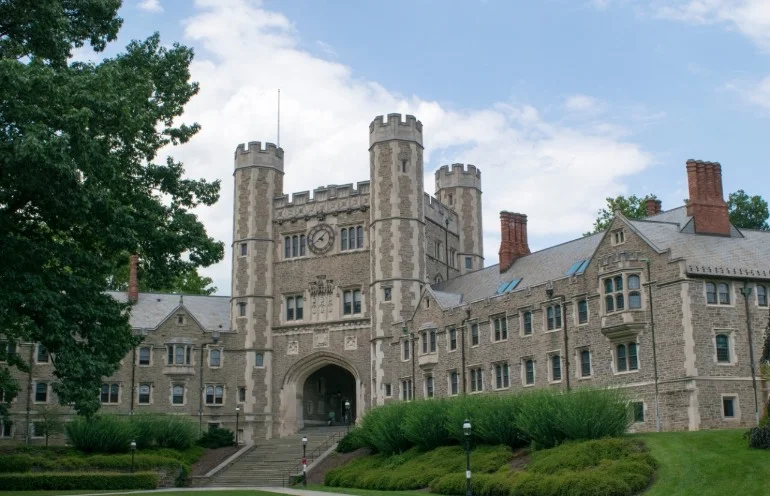
Princeton University, founded in 1746, is an Ivy League institution celebrated for its undergraduate focus and research excellence. Located in New Jersey, Princeton combines historic charm with world-class facilities like the Plasma Physics Lab and Art Museum. The university's generous financial aid ensures accessibility, with a no-loan policy for undergraduates. Princeton's faculty includes Nobel Prize winners and leading scholars who mentor students in small classes. The campus, with its iconic Nassau Hall, blends tradition with innovation.
Princeton's emphasis on independent research allows undergraduates to work alongside professors on cutting-edge projects. The university excels in humanities, engineering, and public policy, with renowned programs like the Woodrow Wilson School. Princeton's residential college system fosters tight-knit communities. Alumni include U.S. presidents, Supreme Court justices, and literary giants. Its commitment to teaching and discovery cements Princeton's status as a top global university.
Getting into Princeton University is a genuine long shot for most applicants. The acceptance rate is 4.5%, meaning admission is reserved for a small fraction of an already strong applicant pool.

Average scores just get you in the conversation here. What actually separates admits from the rest of a strong pool is the essays and recommendations.
Source: IPEDS & College Scorecard (Nov 2025).
Mark November 1 for Princeton University (Single-Choice Early Action — other plans are listed below), with decisions typically out by December 15.
💡 The scholarship deadline (2027/01/01 (Financial Aid)) often falls before the regular admission deadline. Submit your application and FAFSA early to be considered for maximum aid.
Deadlines are verified from official institutional sources but may change each cycle. Always confirm final dates on the official website.
The average GPA of admitted students at Princeton University is 3.93. That makes admissions here extremely selective. Most admitted students carry straight A's, with very little room for a B.
If your GPA sits between 3.63 and 3.93, a high SAT or ACT score is the most reliable way to compensate.
Note the scale: this figure reflects an unweighted 4.0 GPA. Add AP or IB coursework and the equivalent weighted GPA usually lands around 4.13–4.33.Assessment: This tier demands elite, top-of-class academic standing.
Recommended Strategy: Pair the GPA with heavy Course Rigor, including AP, IB, or Honors, to back it up.
This range is a rough map. Where you land determines what else needs to carry weight in your application.:
Data verified via IPEDS, College Scorecard (Nov 2025) and the Common Data Set (CDS). Expert Review led by Sohaib Khan and Dr. Waseem.
Built from Princeton University's own verified admissions data — adjust the sliders below
Adjust the sliders to see how every decimal point affects your outcome.
✅ Verified Data: Institutional records for 2026.
Calculated via College Portal's Human-Intelligence (HI) Methodology & Editorial Standards. Verified by Sohaib Ahmad Khan.
Scores aren't just a formality at Princeton University. Landing within or above the 2026 admitted class's middle 50% keeps you fully competitive, even where submission is optional.
Admitted students at Princeton University average a 1535 SAT (out of 1600).
Very few schools post an average this high; a 1535 puts Princeton University among the most academically selective by SAT alone.
Scored under 1500? A retake is worth it at Princeton University. Two or three sittings is standard for competitive applicants, and there's no cap on how many times you can test.
| Section | Average | 25th Percentile | 75th Percentile |
|---|---|---|---|
| SAT Math | 780 | 760 | 800 |
| SAT Reading | 760 | 740 | 780 |
| SAT Composite | 1535 | 1500 | 1580 |
A score under 1500 puts you in the lower quarter of admits; 1580+ puts you ahead of three-quarters of the admitted class. (These percentiles mark where a given share of the admitted class scored at or below.)
View list of all colleges with average SAT score of 1550
At 1600, your SAT is squarely in Princeton University's favor. That said, admissions staff read the full file. GPA, activities, and essays still carry real weight even with a strong score in hand.
Princeton University's admitted students average an ACT of 35.
Very few institutions post an ACT average this high — 35 is elite-tier.
| Section | Average | 25th Percentile | 75th Percentile |
|---|---|---|---|
| ACT Math | 34 | 32 | 35 |
| ACT English | 36 | 35 | 36 |
| ACT Composite | 35 | 34 | 35 |
At 35, you're in the top quarter of Princeton University's admitted class by ACT score. That's a real advantage, but admissions still reads GPA, essays, and activities alongside it.
The ACT's four sections, English, Math, Reading, and Science, are each scored independently on a 1–36 scale, and admissions staff do notice a lopsided breakdown. If one section trails the others significantly, that's worth addressing before you apply, particularly for STEM programs where Science carries extra weight.
Beyond the number itself, Princeton University weighs your transcript rigor, activities, recommendations, and essays just as heavily. The ACT opens the door, and the rest of your file decides what happens next.
At this tier, the applicants who get in usually have one thing in common: a clear, specific reason Princeton University needed them, not just a strong transcript.
Princeton's admissions committee operates with a single overarching question: what will this student contribute to our community, and how will they leave Princeton - and the world - better than they found it? The implication for your extracurricular strategy is direct: every serious Princeton applicant must have a defining spike - a sustained, visible commitment to one area in which they have shown genuine leadership, intellectual initiative, and measurable impact. Whether that is original scientific research, founding a civic organization, elite athletic achievement, creative work at a national level, or deep community service, this spike must be legible across your entire application: the activities list, the Common App essay, the supplemental essays, and your teacher recommendations should all reinforce the same central identity. If an admissions officer cannot identify your defining contribution within the first two minutes of reading your file, your application is structurally weaker than equivalently credentialed peers who have built a cohesive narrative.
Princeton requires six supplemental essays and short answers beyond the Common App personal statement, including a 250-word academic interests prompt, a 500-word community/diversity reflection, a 250-word service and engagement essay, and three short answers capped at 50 words each. The service essay is Princeton's most institutionally distinctive prompt - the university's informal motto, "In the Nation's Service and in the Service of All Nations," is not a tagline but a genuine filtering criterion, and the committee is evaluating whether your commitment to civic engagement, community improvement, or global service is authentic and sustained or performative. Reference specific Princeton programs - Bridge Year, Community Action, the Keller Center for Innovation, or SPIA - in your academic and service essays to demonstrate that you understand how Princeton's institutional resources align with your genuine goals. The 50-word prompts reward specificity, honesty, and personality over polished presentation.
Princeton offers Single-Choice Early Action (SCEA) with a November 1 deadline and mid-December decisions - a non-binding early plan that nonetheless carries a meaningful acceptance rate advantage over Regular Decision. Under SCEA rules, you may not simultaneously apply to other private universities through any binding ED program or through restrictive EA programs; applications to public universities' EA programs and QuestBridge are generally permitted. Princeton's SCEA applicant pool is both smaller and more intentional than the RD pool, and the committee's own data shows that SCEA applicants are admitted at rates meaningfully above the overall rate. Beyond statistics, applying SCEA signals to Princeton's committee that you have committed your early application energy specifically to Princeton - a signal that matters at a school whose yield rate and community cohesion are institutional priorities. Prepare to submit the graded writing sample (a required component of Princeton's application) alongside your essays before the November 1 deadline.
Princeton is one of the only highly selective universities in the country that requires applicants to submit a graded written paper - an actual piece of academic writing from a class, complete with teacher comments and a grade, uploaded as part of the application. This document is evaluated for intellectual engagement, argumentative sophistication, and clarity of expression. Choose a paper from a core academic subject (humanities, social sciences, or sciences) that demonstrates your analytical depth and writing voice - not necessarily your highest-graded paper, but the one that most compellingly demonstrates how you think. Princeton also offers an optional alumni interview, arranged through local alumni volunteers, and experienced counselors unanimously recommend pursuing it: the interview provides the committee with a personalized, human-voice impression of your character, intellectual curiosity, and interpersonal presence that no document in your file can replicate.
Whether Princeton University is worth it depends less on its reputation and more on your program choice, financial aid package, and career goals. Here's the data to weigh it against.
Admitted students' families report a median household income around $81,400, and graduates see a 3.53% unemployment rate.
Listed tuition runs $80,440/year at Princeton University. Factor in Pell and federal grant aid, and most students land typically much lower.
At Princeton University, 18.7% receive a Pell Grant and 3% carry federal loans. Filing FAFSA early and naming Princeton University on it improves your shot at both.
Ten years out from enrollment, Princeton University graduates report a median income of $110,066, about 171% above the U.S. median graduate income.

These schools have lower average SAT or ACT scores than Princeton University. If your SAT or ACT score is slightly lower, you'll be competitive for these schools.
| School | Location | SAT | ACT |
|---|---|---|---|
| Claremont McKenna College | Claremont, CA | 1514 | 34 |
| Pomona College | Claremont, CA | 1520 | 34 |
| University of Southern California | Los Angeles, CA | 1501 | 34 |
| Wesleyan University | Middletown, CT | 1513 | 34 |
| Georgetown University | Washington, DC | 1494 | 33 |
| Emory University | Atlanta, GA | 1507 | 33 |
| University of Notre Dame | Notre Dame, IN | 1510 | 34 |
| Grinnell College | Grinnell, IA | 1486 | 33 |
| Bowdoin College | Brunswick, ME | 1514 | 34 |
| Colby College | Waterville, ME | 1500 | 33 |

These schools have the same range of average SAT or ACT scores as Princeton University. If your SAT or ACT score is competitive, you'll be competitive for these schools also.
| School | Location | SAT | ACT |
|---|---|---|---|
| Harvey Mudd College | Claremont, CA | 1537 | 35 |
| Yale University | New Haven, CT | 1534 | 34 |
| Northwestern University | Evanston, IL | 1526 | 34 |
| Williams College | Williamstown, MA | 1527 | 34 |
| Washington University in St Louis | St. Louis, MO | 1530 | 34 |
Graduates of Princeton University earn a high median salary of $110,066/year, varying by field.
Tuition at Princeton University runs high, at roughly $80,440+/year, so financial aid planning matters.
18.7% receive a Pell Grant here, below the ~35% national average. Princeton University skews toward higher-income students, though merit aid may still be worth checking.
Princeton University's acceptance rate is 4.5%, which is extremely low. Only top-tier applicants are typically admitted.
The average GPA of admitted Princeton University students is 3.93, reflecting a competitive applicant pool.
There's no strict cutoff, but a GPA at or above 3.63 puts you in the standard applicant pool at Princeton University. Below that, your essays and recommendations need to work harder to provide context.
A GPA of 3.53 or below makes admission tougher at Princeton University, but strong test scores, activities, and essays, plus AP/IB coursework, can still keep you in contention.
Princeton University weighs the SAT heavily. Scoring above 1535, and within the 1500–1580 range, keeps you competitive.
Princeton University's deadline is November 1 (Single-Choice Early Action), with decisions out by December 15.
For priority financial aid consideration, get your FAFSA in before 2027/01/01 (Financial Aid). That's Princeton University's scholarship priority date.
Transferring in is a well-trodden path here. Line up your transcripts, recommendations, and a strong personal statement before applying.
The biggest levers are academic performance, a clear extracurricular focus, and essays that stand out, plus a solid test score where the school considers one.